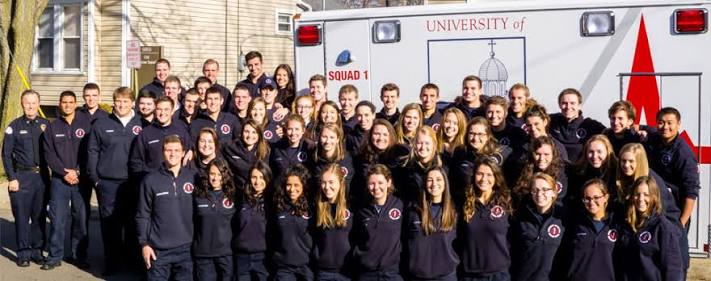
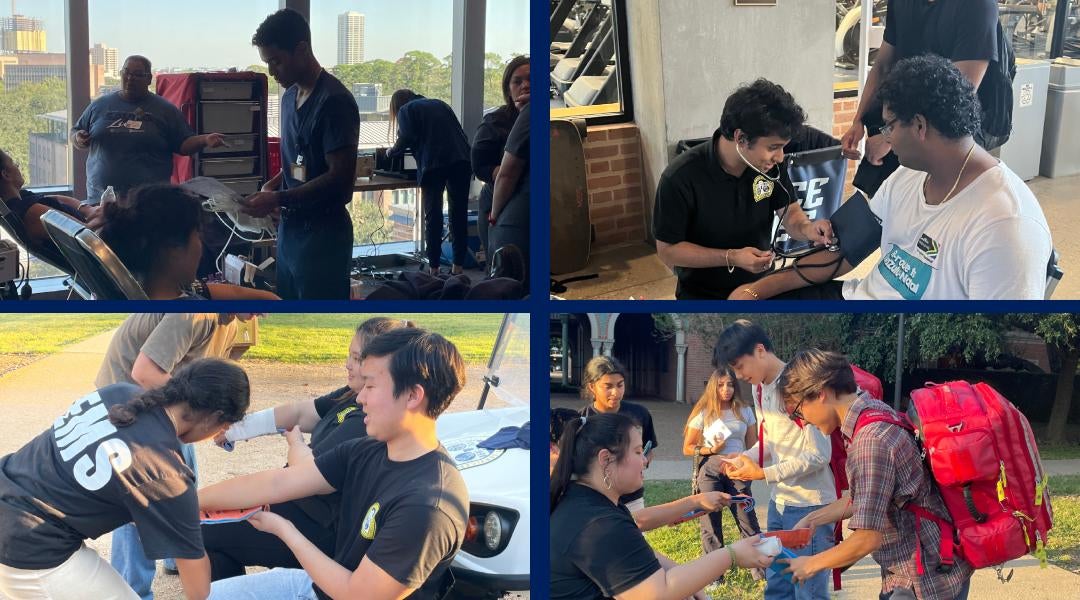
“REMS celebrated the week with a number of community education events — teaching about hands-only CPR, stop-the-bleed skills and vital signs checks — and some fun relay races with EMS equipment in the quad,” said Lisa Basgall, director of Rice EMS. “It’s important to us that we do more than respond to medical emergencies on campus; we want to be good partners on campus in offering resources about learning lifesaving skills. Collegiate EMS is a great way to promote community well-being as well as to remain prepared for emergencies. This is only possible with the contribution of time and service from REMS members across campus.”
REMS is one of approximately 265 collegiate EMS programs in the United States with another 20 programs in North America.
(Photos by Lisa Basgall)
The National Collegiate Emergency Medical Services Foundation (NCEMSF) launched and continues to promote National Collegiate EMS Week. Founded in 1993, the NCEMSF is a nonprofit organization committed to scholarship, research and creating a safer, healthier environment on college and university campuses through the support, promotion and advocacy of campus-based emergency medical services. The foundation is also committed to the advancement of existing response groups and assisting in the development of new response groups.
NCEMSF serves as an umbrella organization supporting its member colleges and universities in providing campus-based emergency medical services. These EMS programs are often student-run organizations comprised of highly trained students ready to respond in any medical emergency. Student volunteers respond within minutes and provide emergency care tailored specifically to their campus community. These groups range from quick-response services on foot or bike to advanced life-support transporting units.
In addition to providing for the acquisition of medical knowledge, campus-based EMS allows student participants to develop certain life skills including leadership, communication and decision-making.
For more information about REMS and the services offered, including free CPR and first aid training, visit rems.rice.edu.
Rice students, staff and faculty dashed to the East Gym amidst the ongoing winter storm to claim one of the hundreds of Moderna vaccines administered on campus Monday afternoon. Harris County Public Health gave the vaccines — which would have otherwise gone to waste due to a power outage at their building — to Rice and other institutions that were already equipped to administer the vaccines. 810 vaccines were distributed to Rice’s campus, according to Harris County Judge Lina Hidalgo.
“[Harris County Public Health] had power outages and had vaccine supplies that had to get into people’s arms by mid-afternoon or they would go bad,” Kevin Kirby, vice president for administration, wrote in an email to the Rice community on Monday afternoon. “They wanted to know if we could inoculate 800 people by using our own personnel who are authorized to vaccinate and whether we wanted the doses. We said yes. Within an hour we set up the vaccination site in the East Gym of Tudor Fieldhouse and staffed it with personnel.”
College magisters were emailed about vaccine availability at 11:06 a.m., and magisters then forwarded the message to students. The vaccines were available at East Gym starting at 11:15 a.m., and hundreds of people were already in line by 11:40 a.m. By 12:30 p.m., students were advised to stop heading to the East Gym for a vaccine dose, because there were more people in line than doses remaining, according to Director of News and Media Relations Doug Miller.
Rice Emergency Medical Services member Christina Oh said that she was asked to help with vaccine distribution at 11:11 a.m., soon after students were notified that the vaccine would be available. Oh said she was encouraged by the response to the news that the vaccines were available.
“It was really gratifying to be of some help, especially when help was needed in such a short time,” Oh, a Will Rice College senior, said. “The moment the news was out, I watched many students come running to the East Gym in the freezing icy cold. Seeing the line wrap all the way back to Wiess [College] made me really happy that everyone was trying to do their part during the pandemic. I’m honored that I was able to help in a small way.”
REMS member Manuj Shah said that REMS Captain Sam Reddick notified him and other Duty Crew REMS members who were on campus and willing to volunteer about the opportunity to administer vaccines.
“The event essentially occurred on a moment’s notice, as our EMS director was only informed around 10 a.m. this morning that we had vaccines coming to campus,” Shah, a Will Rice College senior, said. “It was amazing to see so many volunteers, students and healthcare workers pour into the vaccination site within the hour.”
Martel College junior Flora Naylor said she got her vaccine at around 2:50 p.m. In total, Naylor said she waited over three hours to get the vaccine.
“We were still waiting in line in the gym when [Rice University Police Department] told people to leave the gym,” Naylor said. “At first they told us there were only 175 vaccines left and counted off that number of people, telling those who fell below the cut-off to leave. Then, they said there were only 30 vaccines left and advised us to leave because we were more than 30 people away from the front of the line. At that point we had been waiting for over two and a half hours, so we wanted to hear confirmation that they were completely out of vaccines before we left.”
Naylor said that she was thankful to receive the vaccine and appreciates that Rice pulled off a remarkable logistical feat, although she said there were hiccups in the distribution and the first-come, first-serve basis advantaged certain students over others. For example, students at Hanszen College did not get an email from their magisters about the vaccines until 12:20 p.m., whereas other colleges were informed of the vaccine between 11 and 11:15 a.m. The Hanszen magisters later apologized for this delay.
“Part of me feels guilty for getting the vaccine,” Naylor said. “I am the first person in my immediate family to get it and I do not fall into any vaccination priority groups. It's frustrating that my mum, who is a public school teacher actively going into the classroom, still hasn't been able to get her vaccine.”
McMurtry College senior Ryan Udell said that he was one of the last ones to receive the vaccine at approximately 2:50 p.m. Udell said he arrived at East Gym at 11:30 a.m. after running to campus.
“We were told multiple times to leave and we were not going to get the vaccine but I stayed anyway just in case. It turned out in my favor to stay,” Udell said.
Udell said that he feels relieved to finally be vaccinated.
“Knowing that I will be able to finally hug my grandparents after over a year and a half will be lovely,” Udell said. “The line forming so quickly shows that so many people are eager for the vaccine to help things get better and to feel safer.”
Duncan College freshman Mary-Gwen Milburn said she got the vaccine at East Gym at 3:05 p.m., although she said the line could have easily stretched to Houston Methodist from there.
“It took about four hours for me to make my way through the line. One of the police officers kept telling us that we probably wouldn’t get the vaccine and that we might not want to wait in line through the cold, but I'm glad I stuck through with it,” Milburn said. “The hot water that the Wiess students gave me was the only thing that made the weather bearable.”
While some students waited in line at East Gym for a vaccine, others went to nearby Houston Methodist Hospital, which received 1,000 vaccines from Harris County Public Health due to the power outage, according to Hidalgo.
“Today’s vaccinations were unique. The city gave us 1,000 doses that were going to expire. That’s why it was a cattle call of sorts. This was separate from the usual,” Stefanie Asin, public relations director for Houston Methodist, said.
Kirby said that Rice still has no update from the state of Texas about when they will receive their requested allotment of vaccines. Kirby said that Rice will work with Harris County to schedule second dose vaccinations for people who got vaccinated on Monday, whether they were vaccinated at East Gym or at Houston Methodist.
“All of that information is going back to Harris County. They will facilitate the interaction. We don’t know exactly how people will be contacted, but it should be through Harris County Public Health,” Kirby said.
The vaccines distributed on campus on Monday were designated for people already on Rice campus due to the risks that travel to campus presented. When Rice gets its requested allotment of vaccines from the state, it will likely serve as a vaccination hub for the city.
“What will likely happen is that Rice will serve as a vaccination hub for the city in partnership with one of the providers in the medical center. And so that provider would serve both the City of Houston and our own community,” Kirby said.
Not everyone who went to East Gym was able to get a vaccine. Gabriella Feuillet, a Sid Richardson College senior, said that she was one of the first people in line to leave without a vaccine.
“The officer counted in the gym 175 people and said those were the last 175 vaccines available. I was No. 176,” Feuillet said. “We left immediately, but my friend told me that other people were turned away after us.”
Feuillet said there were around 200 people in line behind her, and that she waited in line from 11:30 a.m. to 2:10 p.m., but getting hot drinks from students handing them out to people in line provided some relief from the weather.
“Everyone around me was so relieved to take some. It was so kind of them and it definitely helped keep my hands warm,” Feuillet said.
Stanley Tsou, a Will Rice College junior, said that when he arrived at East Gym around 11:30 a.m., he was surprised by how long the line was.
“Not only was I hesitant that I would not be able to make the ‘cut-off,’ but I was more worried that I might not be able to withstand the cold long enough before I would have received the vaccine.”
Tsou went to get vaccinated at Houston Methodist after university ambassador Y. Ping Sun started directing students to the second-floor outpatient unit. He said he eventually received the vaccine at 12:40 p.m., after about one hour of waiting.
“I was surprised by how efficient the distribution process went. The line, though seemingly long, moved very quickly, but at the same time I did not feel rushed by the healthcare staff, who still took the time to greet me and asked me if I had any previous allergic reactions to vaccines,” Tsou said.
Jim Zhang, a Will Rice College junior, said that when he arrived at East Gym, soon after the vaccine announcement had been sent to students, people were being redirected to the hospital. Zhang was vaccinated at Houston Methodist.
“They set up vaccinations in one of the waiting lobbies and there was just a whole flurry of people –– some in scrubs, others in jackets [and] everyday wear,” Zhang said.
Zhang said he felt a little tired and his arm was sore after getting the vaccine, but he is appreciative and grateful that Harris County Public Health decided to provide some vaccines to Rice.
“It was all pretty surreal and an unexpected source of hope, I guess,” Zhang said. “I was just talking to some friends about how this part of the pandemic feels especially long because the solutions are out there and in-sight. But getting started on the vaccine a little early definitely combats that fatigue –– just providing a sense of progress and affirming this won't be forever.”
At first, the Rice University Emergency Medical Services faced skepticism over whether it would be a substantial asset to the campus, given that it sits right across the street from the largest network of hospitals in the world. A Jan. 26, 1996 article in the Thresher — almost four months after REMS had been established — said that “some questions have been raised about the overall benefits to the Rice community.” At the time, REMS still lacked university funding.
However, REMS has since proven itself — and gained funding from a variety of sources, including the university and a KTRU grant for EMS education. In 2017, REMS responded to 627 emergency calls. 250 required transport to a healthcare facility, and REMS treated the other 377 on-site. Response times are between two to three minutes, according to REMS director Lisa Basgall.
Basgall, who has been director since 2009, said that REMS plays an important role in ensuring health and safety on campus.
“Rice EMS members come from the campus community, most especially the undergraduates, and this builds trust in the service that is provided and in those who respond to emergencies,” Basgall said.
Doing this work takes a significant time commitment. Basgall said that most members work 24 to 48 hours of unpaid REMS shifts a month. That’s not counting the extensive training they receive before and after they join.
REMS members first have to take an Emergency Medical Technician certification class that lasts about 150 hours and includes practice in the emergency room and ambulance responses in addition to time in a classroom. Even once they are members, they have to maintain their certification with at least 48 hours of additional training every two years. Many REMS members also go on to achieve higher levels of EMS certification, including the highest level: advanced EMT.
“REMS takes training seriously,” Basgall said. “We offer several classes monthly for current members and alumni to make sure providers are ready to go for any emergency.”
“In-charges” go through even more extensive training. In-charges are the on-duty REMS members who direct the emergency response and oversee all of the team’s decisions while caring for the patient. Beyond being skilled in emergency medical care, they have to be prepared for larger incidents, like hurricanes. Basgall said in-charges also build partnerships with campus resources such as RUPD and the Rice Wellbeing Office.
Brenda Zhou is a current in-charge. She started in EMS training three years ago, as a freshman.
“I was really attracted to the fast problem-saving and patient communication that are required for the role,” Zhou, a Hanszen College senior, said.
She loves the adrenaline rush when she gets a call, but her true passion is teaching other EMTs. As education lieutenant for REMS and a teaching assistant for the EMT class, she helps future REMS members learn the skills they will need for their own shifts.
For her, the most difficult part of the shift is not, surprisingly, staying awake. It’s that she can only take care of some patients until they’re taken to the hospital.
“With some patients, I can’t help but worry about their status after we transfer them to the ambulance,” Zhou said.
This year, training the future class of in-charges is especially important since all seven of the current in-charges will be graduating at the end of this semester.
“Rice EMS has been operating smoothly for over 20 years due to a highly regulated and well-functioning system of institutional knowledge, aka the brain of our EMS director, Lisa Basgall, so I do not think it will suffer [from all the graduations] at all,” Zhou said.
Hanszen junior Abigail Tucker is one of the REMS members who will take over as an in-charge midway through this semester. To prepare, she has several courses ahead of her which will give her additional experience with emergency room shifts and ride-outs on ambulances as well as leadership training.
Tucker said she became involved in REMS because it was a tangible way to give back to the Rice community, and because it’s a hands-on opportunity to learn about emergency medicine.
“The best part of being involved in REMS is being able to see the manifestations of my volunteering efforts right in front of me,” Tucker said. “Whether it be bandaging someone’s hand or splinting someone’s ankle, it is so rewarding to see how thankful patients are.”
Members of the Rice community and the general public can receive free hands-only CPR training at Rice Stadium Feb. 6 when the university hosts one of seven training sites in Houston for a statewide effort spearheaded by Rice alum Faroukh Mehkri ’11.
The “Texas Two-Step: How to Save a Life Campaign” event aims to teach over 20,000 people across the state a simple but potentially lifesaving process through fast but focused training.
The 20-minute hands-on sessions will teach participants how to act quickly and to save a life by taking two steps:
Step No. 1: Call 911.
Step No. 2: Begin hands-only CPR by pushing hard and fast on the center of the chest.
According to the American Red Cross, 25 percent of Americans have been in a situation where someone needed CPR. Being trained in hands-only CPR — a technique that involves no mouth-to-mouth contact, only chest compressions — can make the lifesaving difference when someone suffers sudden cardiac arrest.
Mehkri, a former member of Rice Emergency Medical Services (REMS), said hands-only CPR is best used in emergencies where someone has seen another person collapse suddenly. “The hands-only technique increases the likelihood of surviving cardiac emergencies severalfold, and it’s critical that everyone learn since most cardiac emergencies occur outside medical settings,” he said.
It is not only difficult, but terrifying to recognize what to do when a loved one collapses in front of you, Mehkri said. “A 100 things go through your mind and they paralyze you,” he said. “Having a little bit of training to resort to can help you know exactly what to do and start the chain of survival.
The training sessions at Rice will be held every 30 minutes in the “R” Room at Rice Stadium from 8 a.m. to 5 p.m. Participants will practice on mannequins and will receive educational materials summarizing the skills. The sessions will be taught by medical professionals, including members of REMS.
Similar training sessions will take place in all the major cities in Texas. Organizers hope to break the Guinness World Record for the number of people being trained.
REMS Director Lisa Basgall said the event is possible through the collaboration of the medical students and emergency physicians from across the state, joining with undergraduates from REMS to host the event at Rice. The statewide effort involves a coalition of the Texas College of Emergency Physicians, a national nonprofit HealthCorps, Texas Medical Association, American College of Emergency Physicians, and leadership consulting firm MaveRx.
“We hope that many students, faculty and staff from across campus, as well as people from the surrounding neighborhood, will be able to attend the training day to learn these lifesaving skills,” Basgall said.
To register, visit texacep.org. Parking in the Greenbriar Lot will be available for $1.