Rice University News
- Details
- Written by: Scott Savett
- Category: Rice University News
- Published:
- Hits: 0 4497
By Anita Alem
RiceThresher
The Rice University Emergency Medical Services presented a proposal to the Student Association that would guarantee on-campus housing for two In-Charges/In-Charge Trainees per college.
EMS member Nitin Agrawal and Patrick McCarthy, REMS captain and Baker senior, presented the proposal at the SA meeting on April 9. EMS proposes that "the two individuals with the longest time of service within Rice EMS will be guaranteed housing at their current residential college; the colleges that do not have two IC/ICTs are required to offer housing to one individual from another residential college determined [by] a rotating schedule based on founding order."
"For example, if Hanszen [College] had three IC/ICTs, two of them would be guaranteed [housing] at Hanszen, and then the third one would be required to be offered housing by Baker," Agrawal, a Senator and sophomore at Baker College, said. "After Baker offers housing, regardless of the outcome, Baker goes to the bottom of the list and then [the] next IC/ICT who needs housing at a different college would be offered it by Will Rice [College] and so on."
SA President Ravi Sheth said constructive debate and discussion is necessary before proposals are passed, and he stressed the importance of taking this legislation back to the colleges for in-depth discussion.
"Sometimes you need concrete proposals on the table to consider alternatives that could be beneficial, for example, the alternative proposal of guaranteeing all (and not just two) ICs," Sheth, a Martel College junior, said. "At the meeting next week, Senate will be able to vote to pass this resolution, reject this resolution or table [this] resolution to allow for a new proposal to be introduced at the beginning of the year. This is a decision that is up to the Senate, and ultimately, the will of each of the colleges."
According to Agrawal, EMS is concerned that the current situation in which ICs are not guaranteed on-campus housing may impact the response time. Next year, two ICs will be living off campus.
"Rice EMS is able to respond to calls within five minutes while [the Houston Fire Department] has a response rate close to 12-15 minutes," Agrawal said. "The only reason why Rice EMS is able to have such short response rate is because the In-Charges, one of which is required to be at every call, lives on campus and is able to quickly go to any place on campus where the call occurs."
Sheth said the impact this proposal could have on the housing selection will be different for each college, given the diversity of housing-jack guidelines.
"However, I think it is important to recognize how small of a change this will actually be — there are usually only [six to eight] ICs on campus each year, and many of these students already have guaranteed housing," Sheth said. "Ultimately, only a handful of students will truly be affected by any guaranteed housing proposal, and this number is incredibly small in comparison to the total number of on-campus students."
Agrawal said EMS would like for these changes to be implemented in fall 2014 if the proposal is voted on this year. However, Agarwal said REMS is also considering following the Student Association's recommendation to expand the legislation next year to guarantee all ICs on-campus housing instead of two, if the proposal is not passed this year.
"If it does pass, I think it will allow Rice EMS to continue to grow," Agrawal said. "Having the Rice EMS leadership team be on campus will allow them to focus on not only improving patient-care service, but also improve the organization as a whole."
- Details
- Written by: Scott Savett
- Category: Rice University News
- Published:
- Hits: 0 14087
By: Rice News Staff
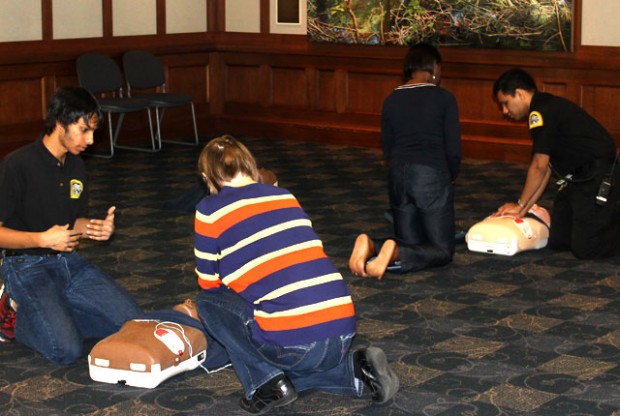
Rice Emergency Medical Services (REMS) celebrated Collegiate EMS Week last week by offering blood pressure checks, giving first-aid tips and teaching CPR. More than 60 faculty, staff and students dropped by to learn life-saving skills at the Jones Graduate School of Business, where REMS offered a “hands-free” CPR course. REMS first-responders taught what to do in case of an emergency, and participants got a chance to practice chest compressions and to use an automated external defibrillator on dummies.
- Details
- Written by: Doug Buchan
- Category: Rice University News
- Published:
- Hits: 0 6321
- Details
- Written by: Scott Savett
- Category: Rice University News
- Published:
- Hits: 0 3806
By: Rice News Staff
Rice News
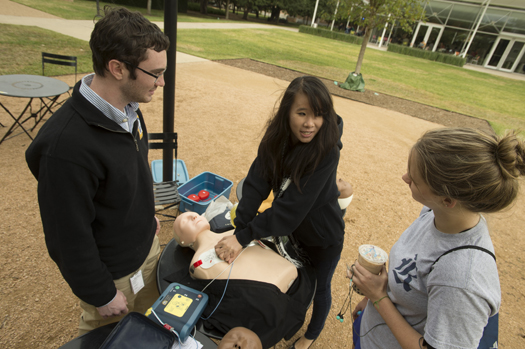
Baker College senior Alison Hightman (right) got a lesson in CPR this week when Rice Emergency Medical Service (REMS) members Nicholas Anhold, a Baker College sophomore, and Eva Ng, a Lovett College senior, demonstrated CPR and other life-saving interventions in the Central Quad. The demo was part of REMS’ celebration of Collegiate EMS Week Nov. 10-18. REMS, which has served the campus community for more than 16 years, also hosted a first-aid class, performed blood pressure checks at the Gibbs Recreation Center and held an open house at its quarters in Duncan College.
- Details
- Written by: Scott Savett
- Category: Rice University News
- Published:
- Hits: 0 4344
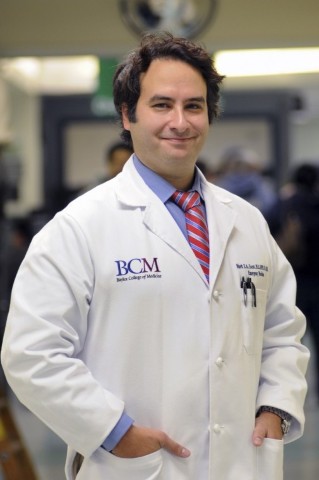
Dr. Mark Escott attended San Jacinto College in 1993, and now serves as medical director of the North Campus’ Emergency Medical Technology program.
San Jacinto College alumni Dr. Mark Escott says he is "coming full circle" as he returns to his alma mater to serve as the medical director of the North Campus’ Emergency Medical Technology (EMT) program.
Escott attended San Jacinto College in 1993 as an EMT student, and went on to attend Rice University, where he earned a bachelor’s degree in religious studies. He holds a master’s in public health from the University of Texas Health Science Center at Houston School of Public Health, and a MD from Flinders University. He served his Emergency Medicine Residency at Penn State University, where he served as assistant professor of emergency medicine.
Escott is an assistant professor of emergency medicine at Baylor College of Medicine’s Houston campus. He also serves as the medical director for Rice University EMS, the Montgomery County Hospital District, and as the associate medical director for Cypress Creek EMS. He serves on the board of directors of the EMS section of the American College of Emergency Physicians.
In his new role as the medical director at San Jacinto College North, Escott will provide valuable consulting, teaching, and evaluating services. His duties in the part-time contract position will include curriculum evaluation, quality improvement, classroom instruction, and clinical evaluation of students.
When he attended San Jacinto College in 1993, he never imagined he would some day return to serve as medical director at the College. "I knew that I would be an emergency medicine physician, but had no idea that I would come full circle," he commented. "But such has been the case in other areas of my career. I started as an EMT volunteer at Cypress Creek EMS, and now I am one of the medical directors. I founded the EMS service at Rice, and now I am the medical director there as well. I found all of these programs to be high quality, and I think that is what motivated me to be a part of them again."
Serving in so many capacities means Escott is a very busy man. Yet, he was willing to take on even more duties as medical director at San Jacinto College.
"I think that it’s important to recognize your roots and where you come from," he remarked. "I also think it’s also important to give back to institutions that have given me something so important. I learned some valuable lessons as an EMT student at San Jac, some that I will never forget. Now that I believe I have something to give back, it is with great pleasure that I do so."
Training and guidance he received at San Jacinto College helped Escott to solidify his career choice. "The College played an important part in my chosen career path," he noted. "Early in my career, I learned excellent clinical skills in evaluation and management of acutely ill patients. It was an important stage in my medical as well as EMS education."
The field of emergency medicine can be challenging, demanding, and stressful, yet Escott finds rewards that money cannot buy.
"I chose this field because I like to take care of patients who are acutely ill, who need rapid medical evaluation," he said. "It involves quick decision-making with little (and at times) no medical information provided by the patient. I find it rewarding because you can make a positive difference in someone’s life on a daily basis, sometimes actually saving lives. You never get tired of that. I love what I do."
Escott offers some practical advice for students about characteristics and qualities it takes to succeed in the field of emergency medicine. "Always smile and have a great attitude," he remarked. "That always goes a long way. Recognize that you are an important part of a team, and that leadership skills play an important role in emergency medicine. Keep your head down, nose in the books, study, study, study. I promise it will all pay off in the end."
San Jacinto College offers a wide range of EMT courses and degree plans at the North and Central campuses.