Webpages
- Details
- Written by: Scott Savett
- Category: Webpages
- Published:
- Hits: 0 20137
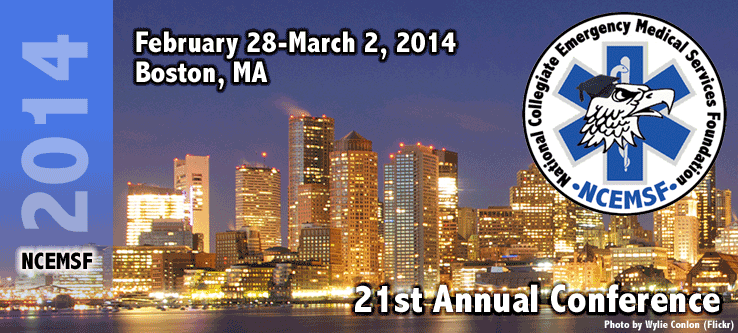
The 21st Annual Conference was hosted in Boston, MA at the Boston Marriott Copley Place (110 Huntington Avenue, Boston, MA 02116) February 28 - March 2, 2014!
1,118 representatives from 111 colleges and universities registered to attend the conference making the 2014 conference the largest gathering of collegiate EMS providers, advisors, medical directors and administrators to date.
2014 NCEMSF Conference Registration Directions
- 21st Annual Conference Program (2014) (PDF)
- Evaluation / Claim CME
- Fees and Policies
- Host Facility
- Transportation
- Skills Classic
- Frequently Asked Questions
- Area Attractions
Questions: Email
- Details
- Written by: Scott Savett
- Category: Webpages
- Published:
- Hits: 0 18987
Why should you start an Alumni Group?
Connecting Alumni:
As students finish college and begin pursuit of a career or post-graduate training, it becomes more difficult for squad members to stay in touch. The close group of people who worked weekly shifts often find themselves in distant cities, working towards completely different career paths.
Through creation of an alumni organization and maintenance of accurate alumni records, helping these squad members stay in contact becomes timely and accessible. Helping alumni members stay in touch with each other promotes the discussion of collegiate EMS memories, which ultimately keeps alumni interested and invested in current squad operations and activities.
Connecting Alumni with Students:
While most undergraduate members are busy running EMS calls and studying for exams, there is always a high level of concern regarding summer internships/employment and post-graduation arrangements. Students often have an array of questions regarding applications, interviews, housing and other areas that relate to the development of summer or post-graduate plans in a new city or environment.
Alumni can serve as a valuable resource to students who are attempting to sort out such career development plans. Many alumni end up moving away from their undergraduate institutions and also pursue career paths entirely separate from collegiate EMS. Connecting students with alumni who are working or living in a similar environment will ultimately keep alumni involved with collegiate EMS and will also benefit current members.
Connecting Alumni with the Squad:
Alumni know and understand how collegiate EMS operates and functions in the context of an undergraduate institution. They have had numerous patient interactions, have sat through dozens of training meetings, and have attended many special collegiate events and activities.
Given this knowledge, most alumni know a lot about how your squad operates on a daily and weekly basis. Alumni members can often provide insight into how to approach the operation and organization of a campus event or how to interact with institutional oversight. Many of the problems facing your current organization, such as funding or staffing, have been addressed by alumni in previous years. Furthermore, alumni can also provide a broad range of training advice regarding topic selection, implementation and presentation.
Begin with an Alumni Database!
The most important aspect in the creation of an alumni organization is the maintenance of current contact information. Having up-to-date contact information will significantly ease communications between your organization and the alumni.
Key information to collect includes:
Name (Last, First)
E-mail Address
Home Address
Current Phone Number (Cell/Work/Home)
Additional information to consider collecting includes:
Date of Birth
Graduation Year
Undergraduate Major/Concentration
Current Employment/Education
Collegiate EMS Leadership Positions
Interests/Hobbies
Maintain the Alumni Database!
Keeping record of the above information is useless if it ultimately becomes outdated. Therefore, it is crucial to contact alumni on an annual basis to ensure that all information is current. In many cases, e-mailing will not be enough to ensure updated information and a quick phone call is required. Given the tedious nature of this task, it is therefore helpful for many organizations to elect a member to fill the role of Alumni Coordinator.
But wait! There are some additional options…
- Facebook – allows for the creation of groups, with the ability to send out group updates and notifications with relative ease. However, many alumni may not have a Facebook account, preventing the inclusion of all members.
- LinkedIn – allows for the creation of personalized profiles and serves as a professional career development platform for alumni and recent graduates. However, many alumni may not have a profile and will be hesitant to join an additional networking site.
- NCEMSF Website – the new website allows for the creation of groups in a similar format to Facebook. Members can maintain an up-to-date profile with NCEMSF that can then be associated with an undergraduate organization. Group e-mails and notifications can also be sent. However, while NCEMSF attempts to regularly contact alumni, the information may become outdated.
What should you offer to your Alumni?
Now that you have a list of alumni with accurate contact information, it is important to keep the group interested and involved with the collegiate EMS squad. There are numerous ways to reach out to alumni. Some of the more common methods are outlined below:
- Alumni Newsletter – an annual (or biannual) newsletter should be sent to all alumni on file with updates regarding squad events, operations, and call statistics. A newsletter is a relatively simple way to keep alumni aware of the overall status of an organization. Newsletters can also serve as a friendly reminder to attend collegiate EMS events and update contact information.
- Spring Barbeque/Picnic – most universities have a spring festival, when alumni return to campus for a weekend full of informational and social events. Holding a barbeque or picnic over this weekend is a great opportunity for alumni to meet current members.
- Winter Formal – many squads hold a winter (semi-) formal event, where members swap uniforms for suits/dresses for an evening of dinner and dancing. Inviting alumni to attend the event further encourages them to remain connected with the squad.
- Training Presentations – while alumni may work in numerous fields, many remain active in healthcare. These alumni can often provide training lectures and presentations on a wide variety of topics. Promotion of alumni teaching helps build professional relationships between students and alumni, while also encouraging alumni to maintain a strong connection with their undergraduate institution.
- Undergraduate Mentoring – pairing undergraduate students with alumni who can assist with questions regarding professional and career development benefits both students and alumni. Alumni are able to feel connected and included with current squad members (with relatively little effort), while undergraduates receive the experience and advice of alumni who have already encountered and dealt with the challenges of post-graduate life and career development.
- Donations/Funding – for many squads, funding for equipment or special events (like attending NCEMSF conferences) is limited. Even small donations, collected from a broad base of alumni, can provide some assistance in budget planning and purchases. Should you choose to contact alumni for donations, consider mentioning a specific fundraising goal, such as “Sending Students to Conference” or “Purchasing a New AED”.
QUESTIONS/COMMENTS: Contact the NCEMSF Alumni Coordinator - Joshua E. Glick -
- Details
- Written by: Scott Savett
- Category: Webpages
- Published:
- Hits: 0 98320
The following conference archives are available (click on a link below):
- 2026 - Arlington, VA February 20-22, 2026
- 2025 - Pittsburgh, PA February 21-23, 2025
- 2024 - Baltimore, MD February 23-25, 2024
- 2023 - Boston, MA February 24-26, 2023
- 2022 - Pittsburgh, PA February 25-27, 2022
- 2021 - Virtual, Sponsored by Zoll February 27, 2021
- 2020 - Boston, MA February 28-March 1, 2020
- 2019 - Pittsburgh, PA February 22-24, 2019
- 2018 - Philadelphia, PA February 23-25, 2018
- 2017 - Baltimore, MD February 24-26, 2017
- 2016 - Philadelphia, PA February 26-28, 2016
- 2015 - Baltimore, MD February 27-March 1
- 2014 - Boston, MA February 28-March 2
- 2013 - Washington, DC February 22-24
- 2012 - Baltimore, MD February 24-26
- 2011 - Philadelphia, PA February 25-27
- 2010 - Baltimore, MD February 26-28
- 2009 - Washington, DC February 27-March 1
- 2008 - Philadelphia, PA February 29-March 2
- 2007 - UMBC & Johns Hopkins Univ. February 23-25
- 2006 - Brandeis Univ., Boston Univ., Massachusetts Inst. of Tech., and Tufts Univ. February 24-26
- 2005 - Villanova Univ. & Ursinus College February 25-27
- 2004 - Johns Hopkins Univ. February 27-29
- 2003 - George Washington Univ. February 21-23
- 2002 - (regional) Univ. of Dayton November 8-10
- 2002 - SUNY Stony Brook February 8-10
- 2001 - Rochester Institute of Tech. February 9-11
- 2000 - University of Delaware February 11-13
- 1999 - Syracuse University February 12-14
- 1998 - Univ. of Hartford & Trinity College April 17-19
- 1997 - Marshall University June 10-14
- 1996 - Rensselaer Polytechnic Institute October 11-14
- 1996 - (regional) Fordham University March 22-24
- 1995 - Villanova University November 3-5
- 1994 - Georgetown University April 8-10
The first NCEMSF Annual Conference was held in 1994. Since then, the annual conference has become the cornerstone of NCEMSF and the centerpiece of campus EMS interaction. Groups wanting information on how to implement or improve campus EMS at their school find a plethora of information available from clinical to administrative to leadership topics. Being able to ask a large group of people specific questions about campus EMS operations is a huge benefit. If campus EMS administration isn't your thing, our medical seminars keep you current on EMS topics.
You might wonder why the conferences have traditionally been clustered in the northeastern United States. The reason is simple: it's where most of the campus EMS groups are located. The bulk of schools with campus EMS are in CT, MA, VT, NY, NJ, and PA. While these six states cover a huge geographical area, we have tried to choose our conference sites to make them within a 6-hour drive of about 80% of campus EMS providers. This practice aids NCEMSF in keeping costs low for our largely college-age attendees and continues to make NCEMSF conference the most affordable EMS educational experience.
Contact:
- Details
- Written by: Scott Savett
- Category: Webpages
- Published:
- Hits: 0 49710
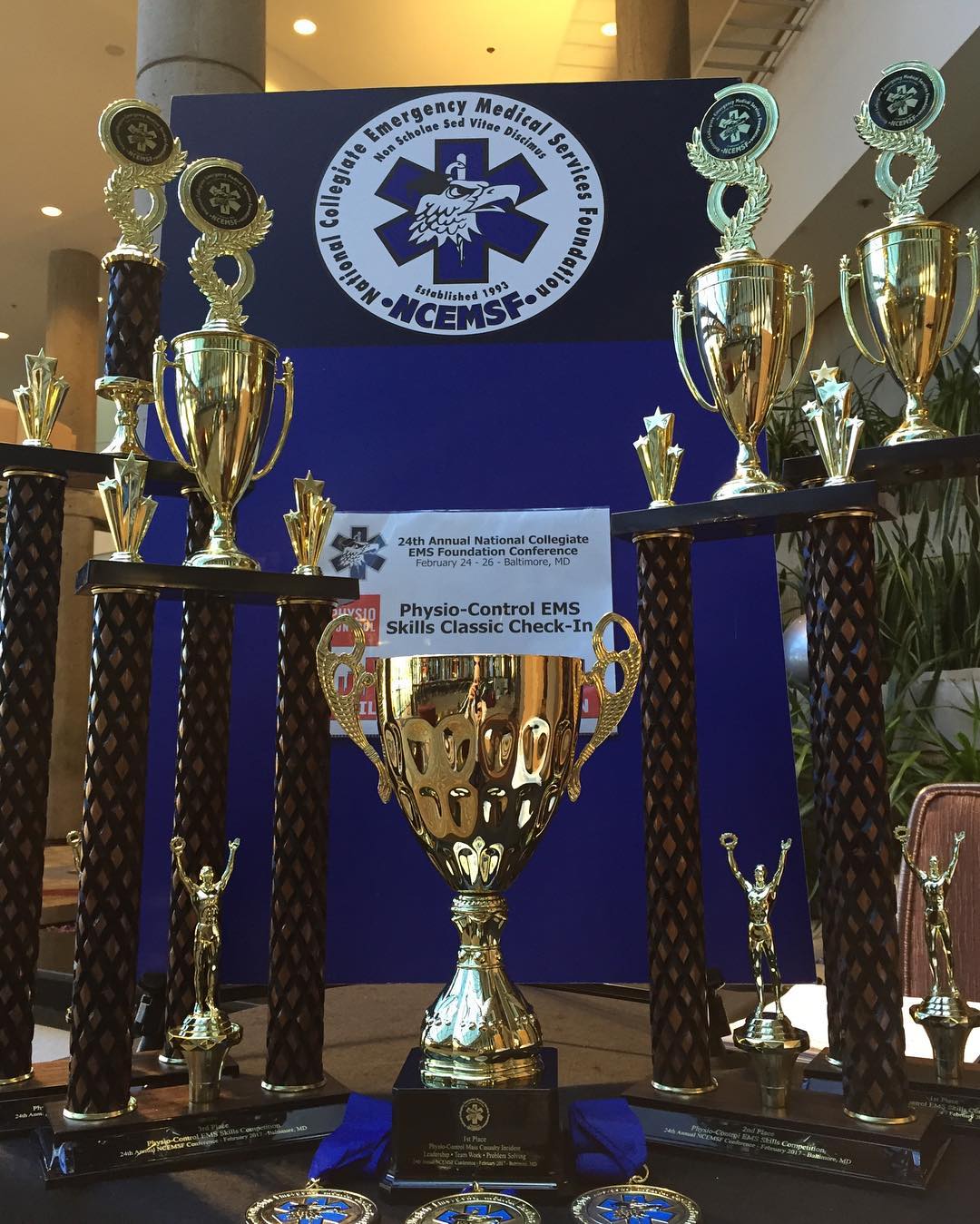
NCEMSF recognizes outstanding efforts made by individuals and organizations through our awards program. Instituted in 1997, the program currently has seven different awards. Follow the links below for the applications for each award.
- Collegiate EMS Week Celebration of the Year
Held annually the second full week in November, Collegiate EMS Week is a week-long recognition and celebration of campus based EMS and provides an annual opportunity for campus-based EMS organizations to highlight their activities and educate their communities. National Collegiate CPR Day kicks off Collegiate EMS Week each year and is designed to educate as many college students as possible in the basic principles of CPR on a single day. NCEMSF receives reports of creative activities celebrating the week, but wants to hear more. Share what your group did to celebrate Campus EMS Week and your organization could win bragging rights. There is no faking it; verifiable documentation of what your group did to honor this special week is needed. Send your press releases, news articles, pictures, public service announcements, and other related materials. Submissions are judged on the basis of activity creativity, appropriateness, and positive exposure generated. - Collegiate EMS Video of the Year
Collegiate EMS Video of the Year acknowledges the video that best embodies the spirit of collegiate EMS and the NCEMSF mission. The rules are simple: The video must be wholly created by members of a campus-based EMS organization. The content of the video must embody the goals, traditions, and spirit of collegiate EMS. Embarrassing, unsafe, indecent and illegal content is prohibited. The video should be no longer than three minutes including intro/pre-roll and credits. Only one entry is allowed per campus EMS organization per year. The video should be DVD quality or higher and should not require special codecs to play. Videos will be featured during annual conference activities. To submit a video, provide a link to a high-resolution copy available for download or online viewing. - Collegiate EMS Community Engagement Program of the Year
This award recognizes efforts by the campus EMS group who had the most creative, effective, and/or innovative program or initiative for engaging with their community. The activity can encompass a variety of outreach methods, including social media, PSAs, websites, or other activities. Judging will be based on the creativity of the messaging, production quality, accuracy of information, and relevance of the topic area to collegiate EMS. For the nomination, please include the following in a single PDF file:- Link(s) to the applicable web content, or attachments of copies of non-web content.
- Information on the effectiveness of the campaign, if available. This can include statistics from social media, websites, or videos. It can also include practical outcomes (for example, in a campaign to register people for emergency alerts, the increase in alert subscribers after the campaign).
- A written self-evaluation of the campaign, to include strengths, weaknesses, lessons learned, and specific actions to take with future campaigns to improve them.
- Collegiate EMS Advisor of the Year
This award honors a faculty advisor, college administrator or medical director who has contributed significantly to the success of campus-based EMS providers and their organizations. Recipients excel at mentoring student collegiate EMS members and dedicate extraordinary time and energy to educating and providing all types of support. - Collegiate EMS Provider of the Year
Nominations for Collegiate EMS provider of the Year awards are accepted in two categories: Collegiate EMS Organization Leadership and Heroism and Valor. Please note the category in your awards submission.- Criteria for nominations for the Collegiate EMS Organization Leadership category include: documented outstanding leadership to a campus-based EMS organization such as through assuming a leadership position, planning and carrying out significant projects for the benefit of the campus (i.e. safety and health promotion and education projects, campus EMS organizational development projects, public relations, etc.) and significantly contributing to the success of the organization. Leadership in and service to other campus and community organizations can be considered, but are secondary to service to the campus EMS organization. Service should be exemplary and well beyond the scope of routine duty. Letters of recommendation and support from academic deans, campus administrators, EMS medical directors, and EMS organization advisors should be included. All nomination letters should be merged into a single PDF file.
- Criteria for nominations for the Collegiate EMS Heroism and Valor category include documented evidence of singular acts of heroism and valor in the line of duty as a campus EMS provider. The award is not made for acts resulting in saving a life or lives, but to individuals for acts of heroism, resourcefulness, and skill in saving or attempting to save a life at great personal risk to their own. Copies of newspaper clippings and certified transcripts of media accounts should be included. Letters from police chiefs, fire chiefs, hospital officials, and campus officials attesting to the acts of heroism and valor should also be included. All nomination letters should be merged into a single PDF file.
- Collegiate EMS Organization of the Year
This award recognizes an EMS organization that has demonstrated outstanding service to its campus. This award is frequently a result of marked improvements in staffing, equipment, or level of service provided. Commonly, these groups hold the NCEMSF Striving for Excellence verification. This award can be self-nominated from within the group, or can be the result of an NCEMSF officer's experience interacting with a particular group (especially during a site visit or outreach program). Either way, as with all NCEMSF awards, supporting documentation and references are needed from the school's administration (advisor, dean, or other school official). - George J. Koenig, Jr. DO Service Award
No formal application exists for this award, which is selected by the NCEMSF Board President.
The NCEMSF awards committee reviews all nominations. Awards are presented each February during the Annual National Conference. Nominations received by the Friday three weeks prior to the start of the conference will be considered for that year’s award.
Submissions in the EMS Week, Video, and Community Engagement categories at times may overlap. The NCEMSF Board reserves the right to take a submission made under this one of these categories and recognize it under one of the other two categories if the Board decides that one of the other two categories is more appropriate, or if moving the submission to one of the other categories would offer a better opportunity for the submission to receive recognition.
For organizational awards, only groups whose Institutional Dues are current will be eligible for selection. For individual awards, the recipient must be a paid Personal Member of the Foundation (personal membership is granted to all Conference attendees, so if the recipient is attending the Conference then they meet the dues requirement). All awards should be submitted using the links above. For awards that require nominations/letters of recommendation, ensure that all letters make the case for the nominee and highlight unique attributes that distinguish the nominee and convince the committee. If multiple letters are submitted, they should be combined into a single PDF, along with any appropriate supporting documentation. Please coordinate submissions for a single individual/organization so that all items are submitted as one comprehensive nomination. The quality of any one submission is more important than the quantity of letters received, especially if multiple letters all come from a similar source or share the same perspective. An organization may submit and win multiple awards. Self-nominating is permitted; however, supporting documentation is required. Submitted materials may be featured in future NCEMSF published media. No submissions will be accepted via postal mail.
Questions on the award criteria may be directed to
In addition to the above awards, NCEMSF also recognizes individual and group achievement through several Conference activities. These include:
- The Richard W. Vomacka Student Speaker Competition
- The Collegiate EMS Research Poster of the Year
- Annual NCEMSF Skills Classic
- The NCEMSF Best Practice Competition
Application details and deadlines for these recognitions can be found in the annual Conference webpages.
NCEMSF recognizes five-year milestone anniversaries starting with ten years of service; no application is necessary, but please verify that your organization's founding date is correct in our Institutional Database to ensure you are properly recognized. Your Regional Coordinator can assist you with accessing your group's website profile. Finally, NCEMSF recognizes members of Collegiate EMS squads who participate in Cardiac Arrest Saves.
Past award winners can be viewed in our Awards Hall-of-Fame.
You may also be interested in NCEMSF's self-evaluative programs. To apply for these recognitions, please use the email address and submission formatting information listed on each program's page.
- MERIT Recognition Program
The National Collegiate Emergency Medical Services Foundation MERIT (Modeling Excellence in Response, Innovation, and Training) Recognition Program is designed to recognize collegiate EMS organizations that adhere to the highest standards of operational excellence, clinical care, training, safety, and community engagement. This program provides a structured framework for self-assessment, continuous improvement, and recognition of exceptional performance in campus-based EMS. The MERIT-Recognized CBEMS Agency designation is not a certification, but a mark of distinction for collegiate EMS agencies that meet or exceed the stringent criteria set forth by NCEMSF. Please note only CBEMS agencies that provide patient care are eligible for recognition—this program is not designed for education-only groups.
- HEARTSafe Campus
The National Collegiate Emergency Medical Services Foundation (NCEMSF) encourages and promotes community awareness of the potential for saving the lives of sudden cardiac arrest victims through the use of cardiopulmonary resuscitation (CPR) and increased public access to defibrillation. In order to increase this awareness, NCEMSF, with support from HEARTSAFE Communities, the American Heart Association, The Sudden Cardiac Arrest Foundation and industry partners, has developed an initiative to designate college communities as “HEARTSafe Campuses.” NCEMSF affirms that the cornerstone of any HEARTSafe Campus is a vibrant campus-based emergency medical response organization.
-
EMS Ready Campus
The National Collegiate Emergency Medical Services Foundation EMS Ready Campus program is designed to recognize excellence in emergency management and disaster preparedness of collegiate EMS organizations. Additionally, the program provides a framework for the enhancement of emergency management education, overall campus preparedness, and response capabilities for the applicant organization. Organizations will have the opportunity to receive recognition through a combination of self-evaluation, dynamic interaction with NCEMSF staff, and by completing a group of prescribed tasks.
The Striving for Excellence in Campus EMS recognition program is no longer offered. The program used an institutional self-evaluation contained in the NCEMSF Striving for Excellence Packet. NCEMSF verified the information submitted in the packet and presented organizations successfully meeting the standards outlined with this validation. The program has been replaced with the MERIT Recognition (above).
- Details
- Written by: Scott Savett
- Category: Webpages
- Published:
- Hits: 0 149086
The best way to contact NCEMSF is via email. This ensures that your message is routed appropriately to the correct NCEMSF personnel. We strive to respond in a timely manner, but please keep in mind that all NCEMSF personnel are volunteers and, as such, our response may not be immediate. If you know the specific person you are attempting to reach, please click on About > Leadership link on the main menu bar above to locate that person. Please select the nature of your question/comment from the list below:
- General Information:
This email address is being protected from spambots. You need JavaScript enabled to view it. - Conference:
This email address is being protected from spambots. You need JavaScript enabled to view it. - EMS Week / CPR Day:
This email address is being protected from spambots. You need JavaScript enabled to view it. - Membership:
This email address is being protected from spambots. You need JavaScript enabled to view it. - New Group Start-up: please see our startup page
- Regional Coordinator Network:
This email address is being protected from spambots. You need JavaScript enabled to view it. - Alumni:
This email address is being protected from spambots. You need JavaScript enabled to view it. - Sponsorship:
This email address is being protected from spambots. You need JavaScript enabled to view it. - Web site / Technology:
This email address is being protected from spambots. You need JavaScript enabled to view it.
Mail:
PO Box 93
West Sand Lake, NY 12196
Phone/Fax:
(877) NCEMSF-1 [623-6731]
Phone Extensions:
100 - General Information
101 - Annual Conferences
102 - Collegiate EMS Week and CPR Day
103 - Membership
104 - Startup
105 - Regional Coordinator Network
106 - Alumni
107 - Sponsors
108 - Dr. George J. Koenig, Jr., NCEMSF President
109 - Dr. Scott C. Savett, NCEMSF Vice-President
110 - Dr. Joshua A. Marks, NCEMSF Secretary
111 - Dr. Michael S. Wiederhold, NCEMSF Treasurer