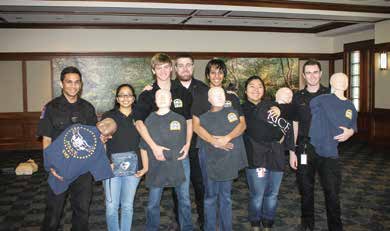
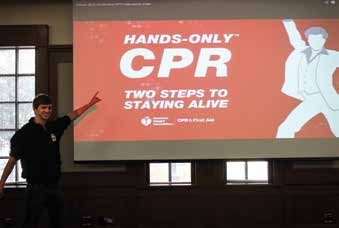
 In Houston volunteers for Rice University EMS offered free blood pressure checks, taught hands-only CPR in the quad and held a special AED and CPR training session for the employees in a campus building where a woman had recently died from sudden cardiac arrest.
Many collegiettes dread getting sick on the same day as a major exam, but for students who serve as volunteer emergency medical technicians (EMTs), they're also hoping someone else doesn't get sick. The life of a collegiate EMT is a stressful one, and walking around in an unflattering uniform is only the least of their worries. Throughout the course of a regular school day, collegiette EMTs have to be ready to respond at a moment's notice to an injured or sick patient on campus and balance their schoolwork and social lives at the same time.
So what does it take to be a member of an emergency medical service (EMS) team in college? Her Campus spoke to three student EMTs to get the full scoop on everything from an average day to the most serious medical scenarios they've faced.
‘Round-the-Clock Responsibility
Claire McDaniel, a junior at Georgetown University, is an acting crew chief in GERMS, which stands for Georgetown Emergency Response Medical Service and is pronounced exactly the way you'd think. Despite its tongue-in-cheek acronym, GERMS is a prestigious emergency response unit with a more than 30-year history. "Sometimes you’re exhausted, and sometimes the calls are difficult," Claire says about her work as an EMT. "There’s a lot less sleep than you think, a lot more late night chart writing, and the calls are so much more vivid and grittier than I imagined." But despite all that, being an EMT doesn't seem to faze her. "I love it, though," she tells us.
GERMS is a completely student-run organization, and just like with most college EMS organizations, the members don't get paid, although they staff their units 24/7 while classes are in session. "The hardest thing is definitely balancing the time commitment and schoolwork, and occasionally trying to sleep," Claire says. Most members on Claire's unit commit to anywhere from 6 to 12 hours a week to the unit, but Claire puts in a little more time. As an officer in her organization, she spends an average of 15 hours on duty a week, and administrative duties add up to 8 hours a week on top of that. In total, it is equivalent to a part-time job.
Kelsey Hirotsu, a senior at Johns Hopkins University, is a crew chief and treasurer of HERO, theHopkins Emergency Response Organization. Kelsey also finds the time commitment one of the most difficult aspects of the job. Her rank as crew chief means that she is in charge of the other members of the four-person team responding to an emergency, and that any decisions ultimately fall on her shoulders. It also means a larger time commitment; while crew members are expected to volunteer for a minimum of one 8-hour shift per week, Kelsey must volunteer for a minimum of 24 hours of service each week, completing three 8-hour shifts. However, many members of her rank spend more than 40 hours a week with a radio clipped to their belts. Although EMTs can attend class and sleep while on duty, they can't leave campus and they have to be ready to respond when their pagers go off. "It was hard to dedicate so much time and to not burn out over the years," she tells us of her four years on the unit. "It was hard to stay focused on why I joined in the first place and to stay above all of the drama and wearisomeness of it all."
Patients... Or Classmates?
Kelsey brings up an important point: there is drama involved when your patients are also your classmates. Kelsey describes being an EMT as a "reality check," especially when you're treating the same people in your classes. "You see someone that you know that was walking and talking and laughing just hours ago, in a condition where her or his health may be in jeopardy," she says. "It’s scary and it makes you realize how valuable life and health is."
Lindsey Mahoney, a senior at Georgetown and another member of GERMS, expands on how difficult it is to treat other members of the student body. "It's more difficult to objectify the situation, and it’s also difficult to see someone that you know suffering," she says. But that's just the tip of the iceberg. Many college EMS units have mandatory transport protocols in place, which means that certain patients have to go to the hospital no matter what. These patients might be intoxicated or under the influence of drugs, have suffered a head injury, or simply be under the age of 18. For universities, it's a way to ensure that all their students stay safe, but it can mean tricky situations for the student responders. "When it’s someone that you know personally refusing to go to the hospital, it’s a little more difficult to be the bad guy and tell the person that they don’t have a choice," Lindsey says.
Another issue that comes up frequently is patient privacy. "It's difficult to not acknowledge the incident next time you see one another," Lindsey says of tough calls that involve classmates. But it's not just awkwardness; she is referring to the HIPAA Privacy Rule, a federal law that governs all healthcare providers, including college EMTs, regarding patient privacy. Responders aren't allowed to disclose any information that could identify a patient, except to the hospital, law enforcement, or a few other special exceptions, and only under certain conditions. And college EMTs don't take HIPAA lightly: violating the law can result in fines or imprisonment. "Often patients don’t realize the strict confidentiality requirements that go into EMS," Lindsey says.
On the Job
Privacy is extremely important because student EMTs witness some of the most stressful moments in their classmates' lives. Kelsey recounts one of her first calls, a seizure patient who was unresponsive when she arrived, and although she can't reveal many details, she notes it as one of the times she was the most scared on the job. "We couldn’t get a blood pressure reading because his vital signs were so wacky," she says. "It’s frightening when nothing on scene is going the way that (you planned) in your head or during practice. It’s even scarier because someone’s immediate health depends on your actions. You can very easily help or hurt someone and not even know it."
Kelsey is an EMT-Basic, which means that she is trained in basic life support. In the field, she can help administer medication, treat life-threatening injuries, take vitals, perform CPR, and conduct many other life saving interventions. EMTs go through rigorous hands-on training classes to get their certifications. At Johns Hopkins, where Kelsey goes to school, most students take about four months of night classes to gain their certifications. Training involves more than 100 hours of class time, as well as shadowing at local emergency rooms and in the field on ambulances. Students learn everything in the scope of practice for an EMT: everything from trauma care such as back boarding and splinting to dealing with behavioral emergencies like panic attacks. But EMT training classes aren't for credit at Johns Hopkins, and there are no pre-requisites: any interested student can sign up to be a part of the team, provided they put in the time and hard work to get onto the unit.
Despite all the hours of training in class, the actual fieldwork can be daunting. "Just my sheer size makes things hard sometimes," Lindsey admits. "Maneuvering the cot and lifting or carrying patients can be logistically difficult when you are 4’11” and barely 110 pounds, but these are limitations that I’ve gotten used to and try to work around as best as possible." But it's not just Lindsey’s size that can make things difficult. "I have had guys who are 6’5” yelling at me, guys who have tried to hit me, and bystanders yell at me for taking their girlfriend or boyfriend to the hospital," she says. "When people lash out it can be frightening. You never know what people will do, especially under the influence of alcohol or drugs."
But not every situation is a horror story. "One call that really sticks out in my mind is one weekend night (when) we had an intoxicated patient," Lindsey tells us. "She turned out to be fine, but her friend came up to me before we left and said, 'Thank you so much for coming to check on my friend. You have no idea how much respect I have for you guys and what you do.’ I think that is the first time it really occurred to me how much I enjoy what I do as a college EMT. Even though we didn’t even bring her friend to the hospital, the fact that I could ease (a) bystander’s worries meant so much to me."
Looking Forward
Kelsey, Claire, and Lindsey all have one thing in common: they all want to be doctors. Each of them cites their pre-med backgrounds as part of the reason they joined their respective units, mainly to gain hands-on experience. "I’d never had any medical experience beforehand, so it was eye-opening to see what pre-hospital medicine is truly like," Claire says. "There’s real people, illnesses, and blood." Although she is pre-med, she says that being an EMT made her question her career choice at times, and it was a good way to make sure she knew what she wanted. "I really had to ask myself if medicine was something I want to keep doing with my life. It is, and I’m really glad that I got that experience before hopefully I get into medical school."
Kelsey has a similar story of how her volunteer work as an EMT helped narrow down her career choices. "It has taught me is that I don’t want to be a trauma doctor," she says. "Trauma is gross!" Lindsey also came into college pre-med, but she was considering a lot of different options. She had public health internships, did some lab work, and worked on behavioral research. However, the joy of working with people through her EMS volunteer work helped her realize what she wanted to do. "I realized that what I liked best out of all of these things was working with patients as an EMT," she tells us. "That was one of the deciding factors in continuing on my pre-med path."
Is it Worth it?
The job comes along with dangerous patients and long hours, but for many of the volunteers, college wouldn't be the same without it. "There’s something about EMS where you know you’re helping your community, regardless of the feedback you get," Kelsey says. Even when the patients aren't thankful, she can still walk away feeling good about herself. But why she loves the work goes deeper than that. "You really have to think on your feet, innovate, and troubleshoot the problems as each one comes your way," she says.
Lindsey, too, feels like being an EMT has allowed her to grow in ways that other activities just don't. "I feel like I’ve learned so much more than I ever would in a classroom," she says. "You cannot learn how to calm a person that’s having a terrible anxiety attack or how to convince an agitated overdose patient to go to the hospital with a textbook." It's precisely this hands-on skill set that she has come to value through her work as an EMT. "I feel so much more confident as a person, and it’s nice to know that if I am ever in an emergency situation, either on duty or off, I have the knowledge and the skills to possibly save someone’s life," Lindsey says. "It’s an incredible feeling."
And, perhaps best of all, life as a college EMT is never lonely. "I automatically found myself with about 90 new friends when I joined," Lindsey says. Claire also loves this about GERMS; she says her favorite part about being an EMT in college is the friendships you make. "You go through some of the most stressful situations together, from the training class through to going on calls together, so you all become incredibly close because of it," she says.
At the end of the day, these three collegiettes all agree that the benefits outweigh the sleepless nights they've given up tending to their injured classmates. So, for now, each of them will keep their radio switched on while they sleep, ready to respond when they're needed.