By Debra Filcman
April 18, 2013
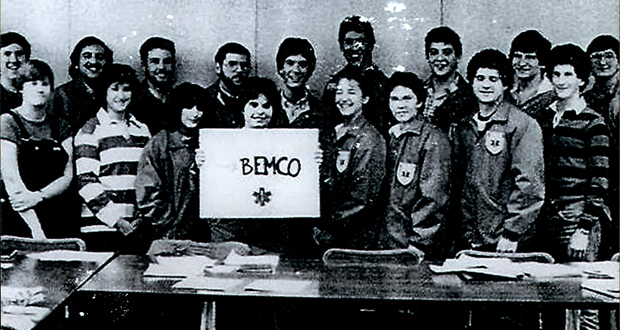
A newly established Brandeis Emergency Medical Corps (BEMCo) received its first call at the start of spring semester in 1983: A woman was in labor at the Lemberg Children's Center.
The call came from university police, via the escort service radios that the three-day-old emergency service used at the time. The handful of student volunteers, recently certified Emergency Medical Technicians equipped with little more than first aid kits, rushed over.
"All I could think was, 'Oh, my God. Where is Lemberg and what do I do when I get there?'" recalls Dr. James Meisel '85, the founder of BEMCo. An ambulance arrived first and he didn't have to find out.
Meisel conceived the idea of a campus-based emergency medical corps when he saw a student walk through a pane-glass window in his freshman year. He was already enrolled in a Massachusetts state Emergency Medical Services course that had begun running on campus a few years earlier. In the fall of 1982, he approached the university administration and the few other universities he could find that already had such an organization in place for advice.
About 750 student members and 7,612 emergency calls later, BEMCo celebrates its 30th anniversary with a gala to be held Saturday, April 20, in Sherman Function Hall. Meisel and President Fred Lawrence will speak at the celebration.
"We were young college kids and we had no experience. A lot of people distrusted us and looked at us with skepticism at best. Many students thought we were just a pre-med club," said Meisel, who in fact went on to become a physician at Boston Medical Center. He added that they also had many supporters, including then University Health Services Director Harris Faigel and longtime Public Safety Director Ed Callahan.
When chaos ensued at a general admission Adam Ant concert in the Shapiro Gym, all doubts were dispelled. BEMCo came to the rescue, treating more than 50 people for hyperventilation, intoxication, trampling and other problems.
Over the years since Meisel and founding members Doug Burd '85, David Klyde '84, Pam Malech '84 and Hugh Mainzer '84 began, the program has grown and improved in myriad ways with assistance and mentoring from university police and administration:
• From an initial $400 allocation from the Student Association to $30,000 guaranteed annual funding
• From a first-aid kit to a license to carry and dispense epinephrine, oxygen, glucose, albuterol, activated charcoal, and soon, nasal Narcan
• From a non-emergency transport car that quickly fell apart to a fully functioning and certified ambulance, as well as a less-conspicuous Ford Taurus.
It operates 24/7 under guidance of the Director of Public Safety and University Health Center.
Today, there are about 70 active members of BEMCo, all certified by the state as Emergency Medical Technician – Basic (EMT-B). They come from a variety of backgrounds and study a variety of subjects, both related and unrelated to emergency medicine. Shifts run 24 hours, during which volunteers go about their daily routines but are on-call and must always be prepared to respond.
"Many think that we're the 'drunk patrol' of the campus on weekends, but we respond to a wide variety of calls 24/7 while school is in session," says BEMCo volunteer Theresa Fuller '13. "'Sick person calls,' which include alcohol intoxication, make up only about 20 percent of our call volume. We respond far faster than regular ambulance companies, we know our community and can provide them supportive care during very difficult times"
BEMCo volunteers have responded to a wide variety of emergencies over the years, including suicides, fatal gunshot wounds and cardiac arrests. Then there are other medical emergencies that volunteers can smile about later.
"I might respond to someone having an asthma attack and the next day I'll borrow a pencil from the girl next to me for an exam and she'll say 'Thank you, I'm feeling so much better!'" says Hannah Goldberg '13. Goldberg, who was debating between going into neuroscience research or training as a doctor. Her work with BEMCo made the decision very easy, she says.
"I really like having patients and interacting," she said.
Fuller, who has risen through the ranks – from tertiary to primary, which requires additional training and at least three months of off-campus EMS experience says BEMCo has also developed a good relationship in the field. When members attend conferences such as the National Collegiate Emergency Medical Services in Washington, D.C., this year, "people are always coming to ask us questions instead of us asking them" as Meisel had decades earlier, Fuller says.
"It enriches folks on so many levels," Meisel said. "It's an important community service, just like the Waltham Group. It's a chance to give back, and it requires medical training, which adds another level of knowledge and professionalism. They are exposed to some people's most private situations and maintaining that trust and confidentiality is at the core of the organization."
By David Nathan
Brandeis Now
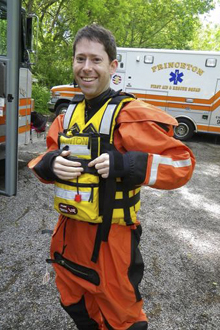 While trying to save a life, Michael Kenwood ’94 lost his own.
The former director of the Brandeis Emergency Medical Corps (BEMCo) died attempting a swift-water rescue during Hurricane Irene on Aug. 28 in Princeton, N.J. He was 39.
Kenwood was remembered as a dedicated family man and committed emergency responder during his funeral on Aug. 31 in Paramus, N.J. Along with family and friends, attendees included more than 100 police, fire and emergency service personnel, New Jersey Lt. Gov. Kim Guadagno, and Princeton Mayor Chad Goerner.
"Michael is a hero," former BEMCo co-worker Peter Simon ’94, the president of the Princeton First Aid & Rescue Squad for which Kenwood volunteered, said during his eulogy, "not for how he lost his life, but for how he lived it – for how he volunteered to make his community better, for how he served our squad, and for how he loved his family and friends."
Simon and Kenwood met while volunteering for BEMCo, which Kenwood led as director in 1993 and 1994. They became friends and shared a suite during their junior and senior years. They reconnected when Kenwood relocated to central New Jersey.
"Michael was thoughtful, insightful, intelligent and a straightforward guy," Simon said at the funeral. "No pretenses. No politics. No BS. You could tell when Michael enjoyed something by the smile on his face and the eagerness with which he talked about it. Emergency services was one of the joys of Michael’s life."
According to an account in the Times of Trenton newspaper, Kenwood and a fellow member of the rescue squad entered a rapidly rising brook around 4:35 a.m. on Aug. 28 to check on a submerged vehicle, which authorities believed was occupied (it had been abandoned).
As they approached the car, Kenwood and his fellow rescuer were called back to land because the current was too strong, the newspaper reported.
Kenwood was subsequently swept into the current. He was pulled unconscious from the waterway farther downstream and then transported to University Medical Center at Princeton, where he died. Kenwood had his own company, Kenwood Technical Consulting. He earned a law degree from Boston University. He lived with his wife, Elizabeth Frenkel, and 3-year-old daughter in East Windsor, N.J.
Michael Kenwood, second from left, with BEMCo members.
"We are deeply saddened to receive the news that Michael Kenwood, former BEMCo member #125 and alumnus of the Brandeis Class of 1994, lost his life in the line of duty in New Jersey during Hurricane Irene," Paul Schneider '12, BEMCo’s director, said in a statement. "Remembering Michael's legacy, we caught a glimpse of his personality and contribution to the organization. It was evident to us that Michael was an exemplary EMT, consistently putting the well-being of others before his own. EMTs such as Michael remind us of why we serve our community in times of emergency. Michael embodied the qualities that all BEMCo members strive to uphold, and we are proud to wear the same uniform that he wore during his service on BEMCo."
Ed Callahan, Brandeis’ director of public safety, recalled working with Kenwood. "He was a very dedicated, professional individual who was committed to serving the Brandeis community," Callahan said. "It’s a tragic situation."
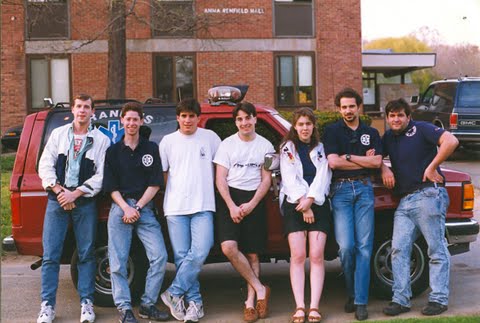 In May 1990, a few months before enrolling at Brandeis, Kenwood was involved in a car accident that changed the course of his life. He shared the story of his epiphany in a 1993 letter supporting his candidacy to serve as BEMCo’s director.
"I will never forget the feeling of fear and helplessness that swept over me as I looked from my two friends, one of whom was unconscious, to the hysterical driver of the other car, to my right wrist, which was deeply lacerated and bleeding heavily," he wrote. "I swore to myself that if I lived, I would learn the skills to care for myself and others should another medical emergency ever confront me again. "Being a member of BEMCo has been highly significant for me," he wrote in the letter. "From the most basic medical perspective, it’s given me the chance to apply and to share my skills as an EMT. Beyond that, I’ve met some wonderfully talented and dedicated people. Finally, it’s given me countless opportunities to grow as an individual."