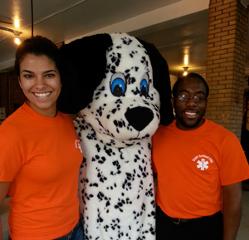
 Last weekend, members of SUNY Cortland’s Emergency Medical Squad (EMS) took a break from their normal on-campus duties to fit toddlers and pre-teenagers into pint-sized firefighter suits at the Great Cortland Pumpkinfest.
The student-run volunteer group’s participation in the annual event, which ran downtown Oct. 4 to 5, is just one of the ways in which the EMS Club is positively involved in the community.
The club for many years has worked closely with the City of Cortland Fire Department not only to drum up support and membership during community events, but to plan an annual, special training program involving a mock “mass casualty” event right on campus — from an “active shooter” incident at Moffett Center to a “gas explosion” at Park Center.
“We’ve been working with the city firefighters long before any of us came here but from now on we’re going to get more frequent updates on future events,” explained Cristina Braun, the 60-member club’s captain and a senior community health major from Floral Park, N.Y.
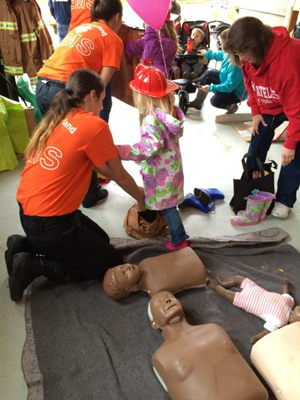 |
| In the city firehouse during Pumpkinfest, Cortland EMS club members helped youngsters try out small emergency outfits and demonstrated the lifesaving techniques they are learning. |
Braun, as well as EMS Club chief Michael Beierle and assistant chief Nicolas Grossmann, measure their commitment in the fact all three currently are seeking to join the ranks of the legendary Fire Department of New York.
“We’re a club but we’re also a New York state agency. We ask members for two 12-hour shifts in a month’s time,” Braun said, noting that officers spend Sunday evenings training and attending meetings. “But beyond that it all depends on how committed you want to be.”
The club is always recruiting for an enterprise that literally never sleeps, explained Grossmann, a senior psychology major from Miller Place, N.Y.
“I think the highest number of members we’ve had is 80,” said Beierle, a senior biology major from Calverton, N.Y.
And new members don’t need to already be certified emergency medical technicians.
“We have instructors to help you do that,” Braun said. On Nov. 8, fresh recruits can get their start with a cardiopulmonary resuscitation (CPR) class arranged for them by the club at Cortland Regional Medical Center.
Some 15-20 members helped out in shifts at Pumpkinfest, familiarizing the public with EMS uniforms and demonstrating blood pressure, splinting equipment and other tools.
“We helped the children put on and take off the little firefighter outfits and demonstrated CPR technique on mannequins,” Braun said.
SUNY Cortland EMS talent will again be on display when the club offers its metal detectors and sharp eyes at key city locations to help families look out for malicious candy tampering among their children’s Halloween treats.
The officers enjoy those social interactions in the community, but they are quick to point out that members in this particular club have a higher purpose.
“I was inspired to work in emergency medical services by my uncle, who is a career paramedic and a deputy chief for the Fire Department of New York,” Braun said.
“I enjoy helping others when they need someone most,” she said. “Working in emergency medical services lets me make a positive impact in many people’s lives and give back to others in ways many people cannot.”
 SUNY Cortland’s Emergency Medical Services (EMS) has come a long way from its modest beginnings in a residence hall storage room — so far, in fact, that the student volunteer group has been named the New York State EMS Council’s 2012 Agency of the Year.
“This award really goes to generations of SUNY Cortland EMS volunteers,” said council director Lee Burns. “Every good thing that’s ever happened to them has been to their credit.”
There are 18 regional councils across the state and each one is eligible to nominate its local winner for the state’s top prize. The Central New York Regional EMS Council named SUNY Cortland EMS its Agency of the Year in May.
A campus volunteer agency taking home the award is rare, Burns said.
“I know very well that SUNY Cortland has come a long way,” Burns said of the student group that was founded in 1976. “So this isn’t specific solely to individuals currently on the squad. It goes to years of Cortland students.”
Susan Barg ’85, who today lives in Ballston Spa, N.Y., was a first-year student in 1981, the year EMS began responding to emergency calls on campus. Up to that point, the student group had held regular first aid courses for students, without a major response role on campus.
SUNY Cortland EMS was “primitive” in its early years, Barg said. The only way for the group to communicate with public safety — now known as the University Police Department — was by telephone. A first-floor storage room in Winchell Hall was converted into a command post with bunks, a television and a few furnishings. And student volunteers responded to all campus medical emergencies by foot, without the luxury of a response vehicle.
“We called ourselves the sneaker patrol,” said Barg, who has worked for the New York State Health Department for the past 26 years. “We used to comment on how many pairs of sneakers we went through in any given semester.”
The group’s budget grew as time went on. EMS members eventually were able to purchase two-way radios to communicate with each other and with public safety. By 1984, two rooms in the former Van Hoesen Hall television studio had morphed into the group’s campus home.
Today, the EMS headquarters in Van Hoesen include “everything a member could need,” according to recently graduated chief Matthew Green ’12. There’s a lounge for its student volunteers, a large equipment room, a patient care room, a kitchen, a bunk room, shower and laundry room. There’s also an ambulance, which serves as a mobile command center, and a first responder truck that EMS uses.
Although many things have changed since the EMS crew’s early days, including a participation boom that has produced an all-time high in membership, a few of the group’s qualities have stayed the same.
“These students were always caring,” said Marley Barduhn, the College’s assistant provost for teacher education and a member of the EMS advisory committee since 1979. “That’s never changed.”
Strong leadership has been a trademark of the most dedicated EMS staffs, she said.
“As four years roll by and an entire group leaves, we’re back to square one,” Barduhn said. “Things are always evolving and you see a legacy of achievement, along with a rising level of expectations, passed along.”
Each year, EMS officers call on alumni members when they’re in the process of making important decisions, Green said. This year, for instance, EMS drafted a mutual aid policy with the Cortland City Fire Department, which says that if the department requires additional medical assistance for its firefighters while they’re battling a fire in the community, SUNY Cortland EMS could be called in to assist.
Green discovered that past members of the College’s squad had developed a similar mutual aid policy several years ago.
“It’s so much better when you’re thinking of a new concept to go to an alumni member and say: ‘Hey, have you guys tried to do this in the past?’” Green said. “With the mutual aid contract, it just made life so much easier.”
Other SUNY Cortland EMS highlights from the past year included its relief efforts with flood victims in the Binghamton, N.Y., area, new programming related to underage drinking on campus and in the community, and responding to hundreds of emergency calls on campus without dropping a single one.
“How many students have thousands of people per week that they’re responsible for?” Barduhn asked. “These are student professionals who have a legal obligation to respond and they have a medical obligation to treat. And they do a great job.”
Barg, the alumna who enjoyed a four-year EMS experience and now works in the healthcare field, praised the “life skills” she developed volunteering. And Green, who is currently working for a private ambulance company near his Commack, N.Y., home, already is aware of them, just two months removed from his SUNY Cortland experience.
“Everyone who joins SUNY Cortland EMS, they become part of this awesome came-from-nothing story,” Green said. “It teaches you important rules to live by in life and in EMS.
“Just keep reaching and keep growing, step by step.”
 From a raised section of Interstate 81 near Binghamton, N.Y., the SUNY Cortland Emergency Medical Services (EMS) team spotted building tops and portions of children’s playground equipment poking above the floodwater in the distance. It was Sept. 10, 2011, and heavy rains had just pounded New York state’s Southern Tier.
"I remember driving there and thinking: ‘We've got some serious work to do,"' said Matthew Green '12, the former EMS chief.
So as the surrounding areas sorted through the devastating flood's aftermath, a brave troupe of SUNY Cortland students leapt into action to help their neighbors to the south. They worked "full force" for 46 straight hours, aiding the Harpur's Ferry Student Volunteer Ambulance Service at Binghamton University, Green said.
The Central New York Regional EMS Council considered that quick response to the flood victims when selecting the SUNY Cortland student group for its EMS Agency of the Year Award. The SUNY Cortland EMS will be honored on Tuesday, July 17, at Drumlins Golf and Country Club in Syracuse, N.Y.
"There's a reason — plenty of them, actually — that they came to the top of the pile of nominations as agency of the year," said Warren Darby, the president of the Regional EMS Council. The award, Darby said, has been presented both to campus and professional emergency first-response crews in the past. It recognizes one agency in a region that covers five counties: Cayuga, Cortland, Onondaga, Oswego and Tompkins.
And it comes for the first time to SUNY Cortland EMS.
"This is something we'd never been able to accomplish, something we probably would never be considered for in the past," Green said.
Founded in 1976, SUNY Cortland EMS is a non-transporting agency, meaning that it does not provide transportation to hospitals. It is staffed by student volunteers 24 hours a day, seven days a week while classes are in session. Its student volunteers are highly qualified in basic life-support skills and there is at least one certified New York state emergency medical technician with each crew at all times.
The last two years, however, have been particularly special for SUNY Cortland EMS, Green said. The group "rebranded" by rewriting its standard operating procedure. It even went so far as to repaint its campus ambulance with a dragon logo and bold red and black lettering to match the College's University Police Department.
"We had become such a professional organization and it was about time that we properly showed it," Green said.
The group's work went beyond written words in a mission statement or a fresh coat of paint. Membership has more than doubled since Green's freshman year — to 67 student volunteers — and morale has ballooned with it. Increased programming efforts, including an educational workshop for local high school and college students about the dangers of binge drinking, have been added by the group.
And SUNY Cortland EMS, which receives between 300 and 400 emergency calls each academic year, hasn't missed a single call in the past two years.
"That says something because we're not full-time volunteers; we're students first," Green said. "These calls don't just come while we're on shift. They come when we're in class and they come at any time during our weekend when we should be out with friends. And we've made them all."
This year, the group also responded courageously to heartache.
While EMS was making the last of its four trips to help flood victims in the Southern Tier in late October, Michael C. Holland, the group's faculty advisor and the College's executive assistant to the vice president for student affairs, died suddenly from a heart attack.
He passed away after helping students deliver emergency supplies and clean up flood wreckage.
"Mike was our biggest advocate and he supported everything we did," Green said, mentioning that Holland cared enough to check on the grades of student volunteers and ask for their opinions on complex EMS-related decisions.
At the student group's end-of-the-year banquet, an event Green called the crowning moment of his EMS experience, members bestowed the first Michael C. Holland "Committed to Excellence" Award to Holland's family. "Committed to Excellence" is an expression that SUNY Cortland EMS lives by and one that Holland exemplified, Green said.
"Whenever we achieve something, he's on our mind," Green said. "And that certainly will be the case (when the group receives the EMS Agency of the Year Award) in July."
Both Green and Darby, who will present the group with its award, said that the honor recognizes more than a single flood-relief effort or a series of effective educational programs. The award, both men agreed, was several years in the making.
"The pride that this group has is palpable, from general member to advisor," Green said. "In collegiate EMS, that's how we survive. With a four-year overturn, if you don't absolutely love this place, if it's not something you can have respect for, then it will sink.
"No one's getting paid here. No one's reaping the reward of (course) credits. It comes from loving the organization, loving the people in it and knowing that you're doing a great thing."
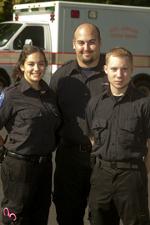
Other SUNY Cortland past and present EMS officers who will receive the EMS Agency of the Year Award with Green include: Katherine Aylward '12, Austin Glickman '12, Sean Jolliff, Devon Keir, Rebecca Schwartzman '12, Katharine Warszycki and Alexander Watkins. Scwartzman, Gilckman and Green are pictured above to the left.
By Jennifer Larson, AEMT-CC
JEMS
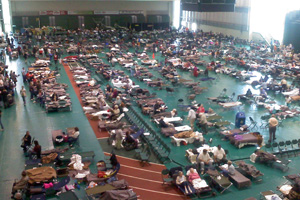 Sept. 7 seemed like just another rainy day in Binghamton—typical for a late summer afternoon in the Southern Tier Region of New York. The usual flood warnings were in effect because the Susquehanna River, which flows through the heart of Binghamton, rises and falls with the changing seasons. As the afternoon went on and the weather worsened, however, Tropical Storm Lee proved to be far from a typical summer storm. With last resort flood walls built to 25 feet and the river expected to rise a record two feet above that, it became clear that a flood emergency was imminent.
Preparation
In 2006, a major flood struck rural parts of Binghamton. Binghamton University opened the doors to the Events Center—its main athletics arena and concert venue—and sheltered hundreds of displaced people. Harpur’s Ferry Ambulance (HF), Binghamton University’s student-run 9-1-1 ambulance agency, was responsible for providing emergency medical care for approximately 2,000 evacuees. The Events Center was opened as a community shelter once again as the 2011 floor worsened.
At 4:30 p.m., Campus Emergency Manager Dave Hubeny sent a text message alert asking the incident management team personnel to report to the Events Center to staff the command post. Shortly after, the campus was notified that the Events Center was open as an evacuee shelter.
HF immediately mobilized available personnel. HF Chief Robbie Cohen and Operations Director Pavel Antonov reported to the Command Post for a briefing and to review the incident action plan. HF would once again take on the role of providing emergency medical care and transport to the evacuees. They set up a treatment room to provide care to patients and moved all HF operations to the Events Center.
Flood Response
HF isn’t a traditional EMS agency. Staffed and led by Binghamton University students, it responds to more than 800 calls a year, both on campus and as mutual aid throughout Broome County. It runs two ALS ambulances and two ALS fly cars, making it one of 10 collegiate volunteer EMS agencies to offer this high standard of care.
HF staff comprises full-time Binghamton University students, who also work as part-time employees and volunteers at other EMS agencies. The members of HF provided 24-hour care for 11 days at the Events Center Shelter while covering the usual campus calls.
Fifty members of HF rose to the occasion by providing exemplary care to patients unique to a college campus. A large portion of the evacuees suffered from chronic illnesses or disabilities that aren’t widely seen in the university population. Thanks to frequent agency trainings and conferences, responding providers were able to treat these conditions with confidence and skill.
HF treated patients of all ages with such minor medical issues as mental-health crises, seizures, strokes and one cardiac arrest. Deputy Director Alex Nello and Captain Kate Olofson coordinated 12-person crews for six- or 12-hour shifts to staff ambulances and provide care to the Events Center population.
Intercollegiate Assistance
As the incident developed and no end was readily in sight, the need for downtime and relief for HF personnel grew significantly. Chief Robbie Cohen contacted the leadership of State University of New York (SUNY) Cortland Campus Rescue and SUNY Oneonta Emergency Squad to supplement HF and their state-assigned mutual aid crews from Guilfoyle Ambulance and SeniorCare EMS.
Not only did they provide skillful care, but their assistance also permitted HF providers some well-deserved time off. This is the first time in HF history, per mutual-aid policy, that intercollegiate assistance was requested.
Training
The trainings and standard operating procedures of HF enabled the initial crew to effectively respond. Binghamton University routinely invites performers and athletic teams to campus for concerts and tournaments, many of which generate a high number of calls. HF plays the integral role in providing medical care, operating a treatment room and establishing EMS command. Working these events provided the training and practice that was essential to the success of the Events Center shelter, as the incident command system has become a familiar part of HF event response.
The volunteerism, preparation and professionalism of HF providers and collaborators allowed for the smooth operations of the Events Center treatment room. During this 11-day event, the responding providers rendered care to 257 patients. Accounting for one-third of the usual, annual call volume, this was a major incident. Thanks to the cooperation among HF, Binghamton University, the Red Cross, the Broome County Department of Health and Federal Emergency Management Agency, the shelter was quickly established, and safely and efficiently maintained. The operation closed smoothly.
Conclusion
The Flood of 2011 was handled extraordinarily well because of the skill and dedication of the HF membership, the support of local volunteers and the trainings and experience with ICS at Binghamton University events. The response to this flood served as a testament to the capacity for compassion and professionalism of HF and the Greater Binghamton community as a whole. As the City of Binghamton and the surrounding area rebuilds, the members of HF continue their dedication to providing exemplary medical care to Binghamton University and the Southern Tier of New York.
CORTLAND, NY (10/31/2011)(readMedia)-- The SUNY Cortland community is deeply saddened by the loss of Michael Holland, a respected and well-liked SUNY Cortland administrator for more than 30 years, who passed away Saturday after helping student volunteers assist flood victims in Binghamton.
Holland, 52, suffered an apparent heart attack while returning from a student clean-up involving members of SUNY Cortland's volunteer ambulance squad, which he had advised since 1984.
"Mike passed away doing exactly what he loved most-helping others," said SUNY Cortland President Erik J. Bitterbaum. "Everyone who knew Mike will remember him as a friendly and upbeat person who would do anything for those in need. Whatever the cause, whatever the issue, Mike was always there to step in and lend a hand. And he loved working with students."
Calling hours will be Wednesday, from 1 to 3 p.m. and from 5 to 7 p.m. at the Perkins Funeral Home, 55 West Main St., Dryden. A funeral mass will be held at 10 a.m. Thursday, at Holy Cross Church, 375 George Road, Freeville. Burial will follow in Willow Glen Cemetery, Dryden.
Holland, the executive assistant to the vice president for Student Affairs, is survived by his wife of 28 years, Joanne Frantz Holland, and four children: Michael Jr., Mary, Dan and Kate.
"Above all else, he was a devoted husband and father and a great person and friend," said Ray Franco, SUNY Cortland's vice president for institutional advancement, who hired Holland as a residence hall director in 1981.
"Mike had a real passion for working in higher education," Franco said. "He always was most interested in doing what was in the best interest of our students. He was eager to pitch in and do whatever it took to help the College and the Student Affairs division be successful. We could always count on Mike."
Holland was a recipient of the Chancellor's Award for Excellence in Professional Service, one of the highest honors bestowed by the State University of New York system. He received his bachelor's and master's degrees from Indiana University of Pennsylvania, and spent his professional career at SUNY Cortland, working for the Student Affairs office.
At SUNY Cortland, friends recalled his wonderful sense of humor and contagious laugh. He was actively involved in issues involving the College's relationship with the surrounding community and played a key role in SUNY Cortland's hosting of the N.Y. Jets training camp on campus. Holland served as an academic advisor to students and groups, including the Kappa Sigma fraternity and SUNY Cortland EMS, a 58-member corps of student volunteers trained in emergency medical service.
"He was like our campus father," said Matt Green, chief of the student-run ambulance service. "He's the one who called us to see how we're doing, made sure that we're doing well in school, that we had what we needed. He was always in our corner."
So when SUNY Cortland EMS had trouble finding a certified driver to help take a van filled with volunteers and relief supplies to the Binghamton area for a joint cleanup with SUNY Albany and SUNY Binghamton, Holland was quick to volunteer.
Holland and 10 SUNY Cortland students traveled to Binghamton in three vehicles filled with supplies collected during a campus-wide drive for food, cleaning materials and other necessities. Eight of the students were EMS volunteers, and two were volunteers from Kappa Sigma, Green said. Once there, Holland helped with the cleanup.
Holland began driving the van back to campus on Interstate 81 with three student EMS volunteers as passengers. About 29 miles south of Cortland, Holland experienced distress. The van veered to the right, off the road, and hit a tree, Green said. None of the people inside the van were hurt in the crash.
The student passengers immediately pulled Holland from the vehicle and began administering cardio-pulmonary resuscitation. About 11 minutes after the crash, rescue crews arrived and took over. Holland was transported to Wilson Memorial Hospital in Binghamton, but nothing could be done to save him.
"Mike will be sorely missed," said Vice President for Student Affairs Greg Sharer. "He was a wonderful colleague and friend.
"Mike touched many lives in his too-brief lifetime. He truly possessed a caring, kindness and generosity of spirit that came through in all that he did. That Mike spent his final day volunteering with students to provide flood relief is a testament to who he was."
In lieu of flowers, the family has requested that memorial contributions be made to a scholarship fund set up in his name. Gifts may be sent to the Michael C. Holland, Sr. Scholarship, c/o Dryden Central School, P.O. Box 88, Dryden, NY 13053-0088.