By: Sophia Angele-Kuehn
The College Voice
As the imminent dawn of college approached, first-years wisely overestimated while packing. Once in their separate dorms, they shoved granola bars, packs of water bottles, and the odd first aid kit under their beds, having no clue as to what surprises campus life would bring them.
After one week into the school year, Conn was already facing impending Tropical Storm Hermine, as well as homework deadlines on Moodle. Fresh, summer mornings turned into split-second showers and winds that flipped umbrellas. As night approached, the Emergency Response Team emailed the campus community, warning against falling tree branches and giving preparation advice if the power ever blinked out. In the second email sent out that Labor Day weekend, Richard Madonna, Vice President of Finance and Administration and also chair of the Emergency Response Team wrote, “I urge students – and all faculty and staff who are on campus tonight – to be mindful of your safety and limit your outdoor movement on campus for the remainder of the night.” Meanwhile, young hopefuls were venturing out to their clubs’ first meeting of the year. Near Becker House, a fallen tree damaged cars.
In the midst of the storm that never quite fully hit, the campus was forced to consider the college’s policy on storm preparedness and the importance of Connecticut College’s Emergency Medical Services – members of which linger in the background of events, close at hand, ready to rush in with the necessary care before the ambulance arrives. They work at club sporting events and on weekend nights with Campus Safety – just in case.
The Emergency Response Team, however, is ready for nature well in advance. “When it comes to weather and storms, the moment we see any chance of inclement weather coming our way, the team will begin to discuss preparations, supplies on hand, potential risks, and how to mitigate the risks, and then we begin to set up regular conference calls to monitor the weather and discuss actions,” said Madonna.
If the situation becomes critical, the College will post on its social media pages and email, call, and text the campus community. “And, when the routine business of the College is interrupted, we also post a banner on every page of the website – yellow for business interruptions, red for serious emergencies,” remarked Stewart Smith, director of Campus Safety.
As to losing electricity, Smith explained, “If the power went out on campus, we do have backup generators that power some areas, such as the library and Harris Refectory, so we can keep our computer systems running and provide food to our students. We also have the ability to bring in generators that can be moved around campus as appropriate, so we can support other needs as they arise.”
Regardless, students and staff should take it on themselves to be cautious and well-equipped before the next calamity strikes campus. The Emergency Response Team provided tips in their email (put fresh batteries in flashlights, charge all electronics…) while the wind whistled through dorm windows. But how can one prepare for the next storm thrown at Conn? “One can never plan for every storm Mother Nature throws at us, but we can try our best to be prepared, ensure the safety of our students, and in the unlikely event of a storm, ensure that the campus is back up and running as soon as possible,” said Madonna.
Connecticut College has a comprehensive emergency team that warns its students, which begs the question – do other colleges?
Wesleyan University, just 45 minutes from New London, has an emergency notification system called “BlackBoard Connect” and a Campus Community Emergency Response Team, similar to Connecticut College’s. The University Of Massachusetts Amherst also has a campus EMS agency made up of students trained as Emergency Medical Technicians. Our college’s EMS club also offers an EMT-Basic Training course each semester that students can take for one academic credit.
By protecting the campus from everything involving natural disasters to sports injuries, these services ensure our comfort here at Connecticut College. These students and staff learn how to save a life, and stay brave even in the face of the storm.
Press Release, Connecticut College
Connecticut College's Emergency Medical Services (EMS) club installed a new Automated External Defibrillator (AED) in the Crozier-Williams student center during a small dedication ceremony earlier this week.
The $1,900 device, which can detect and treat the irregular heartbeats that lead to sudden cardiac arrest, was donated by Emergency Medical Technician (EMT) instructor Chuck Holyfield and Connecticut College's Fall 2011 EMT class, in memory of Elizabeth Durante '10. Durante, who founded the College's EMS club in 2008 with Stefanie Hinman '10, was killed by a drunk driver in March of 2009 while on her way to a humanitarian mission in Africa.
"Liz was quite the humanitarian, and we wanted her name to live on," Holyfield said. "We decided this was something we could do."
An all-weather, alarmed box for the device was donated by Common Cents EMS Supply in Old Saybrook. The box is located between the post office and the convenience store on the first floor of the student center. The College also has two other AEDs, located in the athletic center field house and with campus safety.
The College's EMS club is a student-run organization that currently includes 21 licensed EMTs and 14 students in the process of getting their EMT licenses. The club offers EMT classes for students (taught by Holyfield on campus) and works with the College's campus safety officers to provide emergency medical services at campus events, club sports games and when called.
Club president Ben Allar, a junior pre-med student with double majors in biology and religious studies, said EMS club members commit to 200 hours of training and take the EMT course and practical skills examination on campus. To help offset the cost of the training for students who can't afford it, the club offers the Elizabeth Durante '10 Scholarship.
"If students are willing to put in the hours for training, we are willing to help them pay for it," Allar said.
Student EMTs are trained to provide first aid, evaluate injuries and respond to medical emergencies. While most EMS club members are pre-med students, Allar said anyone with an interest in helping people is welcome to join.
"Our goal is to grow the club and train at least 10 new EMTs each semester," he said.
This spring, the club will begin offering CPR classes on campus as well. Allar hopes to have as many people as possible trained to administer CPR and use the College's three AEDs.
"When someone is experiencing sudden cardiac arrest, every second matters," Allar said.
Allar added that while EMTs and those who are CPR-certified are trained to use the AEDs, the machines come with directions and can be used by any bystander. "They are very user-friendly," he said. "The AED won't let you shock someone with a normal heartbeat."
Holyfield said he is glad that the College now has third AED in a central location on campus, but added that he would prefer the device never has to leave its box.
"I hope it never has to be used," he said.
For media inquiries, please contact: Amy Martin, 860-439-2526,
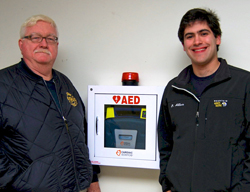 EMT instructor Chuck Holyfield (left) and EMS club president Ben Allar '13 with Connecticut College's new Automated External Defibrillator (AED)