by Rebecca Flowers
Since its founding in 1991, Dartmouth Emergency Medical Services has made strides in outreach and coverage. These efforts, driven by students, has brought the organization the Striving for Excellence and HEARTSafe Campus awards at the 2017 Conference of the National Collegiate Emergency Medical Services Foundation, which was held this February in Baltimore, Maryland.
A student-run program founded in 1991, Dartmouth EMS is an active member of the National Collegiate Emergency Medical Services Foundation. The foundation was founded in 1993 in order to connect collegiate EMS teams across the country, according to Northern New England Regional Coordinator at NCEMSF Kate Marquis.
Every year, NCEMSF hosts a national conference, which includes speakers, networking events and a “skills classic,” in which teams are tested in a variety of scenarios, Marquis said. Over 100 teams attended the conference, this year, which also includes an awards ceremony.
In the 2014-2015 academic year, current director of operations for Dartmouth EMS Joseph Minichiello ’17 and Brett Teplitz ’15 worked on a proposal to help Dartmouth EMS become independent of Dartmouth Hitchcock Medical Center by operating through the American Heart Association.
Minichiello said that this gave the program more independence and control, generating significant growth.
“My freshman year about 200 people that year got certified [in first aid and CPR], and then we had almost 500 students the following year once we became independent,” Minichiello said.
Dartmouth EMS saw similar growth in the number of certified CPR instructors from three instructors before the program’s expansion to more than 25 now, which allows them much greater public outreach, according to Minichiello. Moreover, Dartmouth EMS has a community training program for first aid and CPR. Minichiello said training is especially in demand in the spring term once First-Year Trips leaders and Croo members have been accepted, with three to four CPR and first aid classes per week.
“This weekend alone coming up there’s four classes with up to 24 people in each of them, so you’re looking at 80 plus people,” Minichiello said.
Community training can also include faculty and graduate students and other community members. The chemistry department, for example, requires the training for some of its faculty, and, in recent years, some local coaches arranged classes for their hockey team.
One recent example in the Dartmouth community was the incident at the Dartmouth Idol Finals in which a musician collapsed and was resuscitated by CPR. One of the students that responded took a CPR class with Dartmouth EMS, Minichiello said.
“[It’s] really rewarding to see the impact that we do have on the community,” Minichiello said.
Though shifts, training and other services take up a large portion of the week, the team also holds weekly internal training sessions, which can include anything from scenario simulations to case reviews to lectures.
“Next week we’re having a pediatric lecture by an [emergency room] doctor talking about differences between adults and pediatrics, whether that’s anatomically or physiologically or psychologically and how we can best address those differences when we’re interacting with pediatric patients,” Dartmouth EMS director of training Ian Speers ’17 said.
The Striving for Excellence award is given to the EMS organization that represents “the gold standard for campus EMS delivery and care,” according to the NCEMSF website.
In the application for the award, Minichiello said Dartmouth EMS had to prove its “preparedness,” an assessment that included how many hours of coverage its members provide with regular shifts, how large its training program is, how closely it interacts with other emergency agencies such as the Hanover Fire Department and the protocols it has in place. The application for the award also included a section about maintaining the safety of the providers, which, at Dartmouth, includes bloodborne pathogens training through the Office of Environmental Health and Safety.
Creator of the HEARTSafe Campus award at NCEMSF Josh Glick adapted the award from a designation by the American Heart Association for communities with high preparedness and heart health awareness. Glick himself described the 11-page application as “extensive.” It requires demonstrating that the EMS team has trained a minimum of 2 to 4 percent of its college’s population, depending on campus size, that the team has extensive access to automatic external defibrillators and show that its response times are below minimum threshold.
The team must also collect letters of support from administrative officials and demonstrate that it has promoted cardiac health awareness on campus.
Only 25 collegiate EMS teams have been recognized in the last five years for the HEARTSafe Campus award. Both awards are self-nominating and require separate applications.
“If you recognize that there are over 200, 300 organizations in the country for collegiate EMS, and there are dozens more college campuses, to be one of a select few that have met the requirements that we’ve laid out is pretty impressive,” Glick said. “We were proud to congratulate Dartmouth for winning the award.”
Reposted from http://www.thedartmouth.com/article/2017/05/dartmouth-ems-expands-collects-accolades
Dartmouth’s student-run Emergency Medical Service was named the New Hampshire’s EMS unit of the year by Concord-area medical services company Bound Tree Medical yesterday for its positive impact at the College.
The award recognizes EMS units that have improved their community through acts such as patient care, their relationship with the public, education programs, prevention-oriented initiatives or other related activities. Dartmouth EMS was selected as the award’s recipient by the merit committee, a body organized by the state’s Division of Fire Standards and Training and Emergency Medical Services.
“It’s definitely great to be able to give back to campus in this way because we’re providing a great service to anyone who needs our help, whether that’s through certifying people in first aid and CPR or responding to their emergencies,” Dartmouth EMS executive director Bill Crockatt ’16 said. “One of our mottos is ‘people helping people,’ which is really simple but I really think it does speak to what our organization does — we’re just a bunch of students trying to look out for our fellow peers.”
Dartmouth EMS is hoping to expand to 24-hour services over the next few years, increase standby coverage at events and secure its funding, Crockatt said.
“It really speaks to the dedication of our members and all the hard work everyone for the past decade has put into Dartmouth EMS and growing it and getting it to what it is today,” he said.
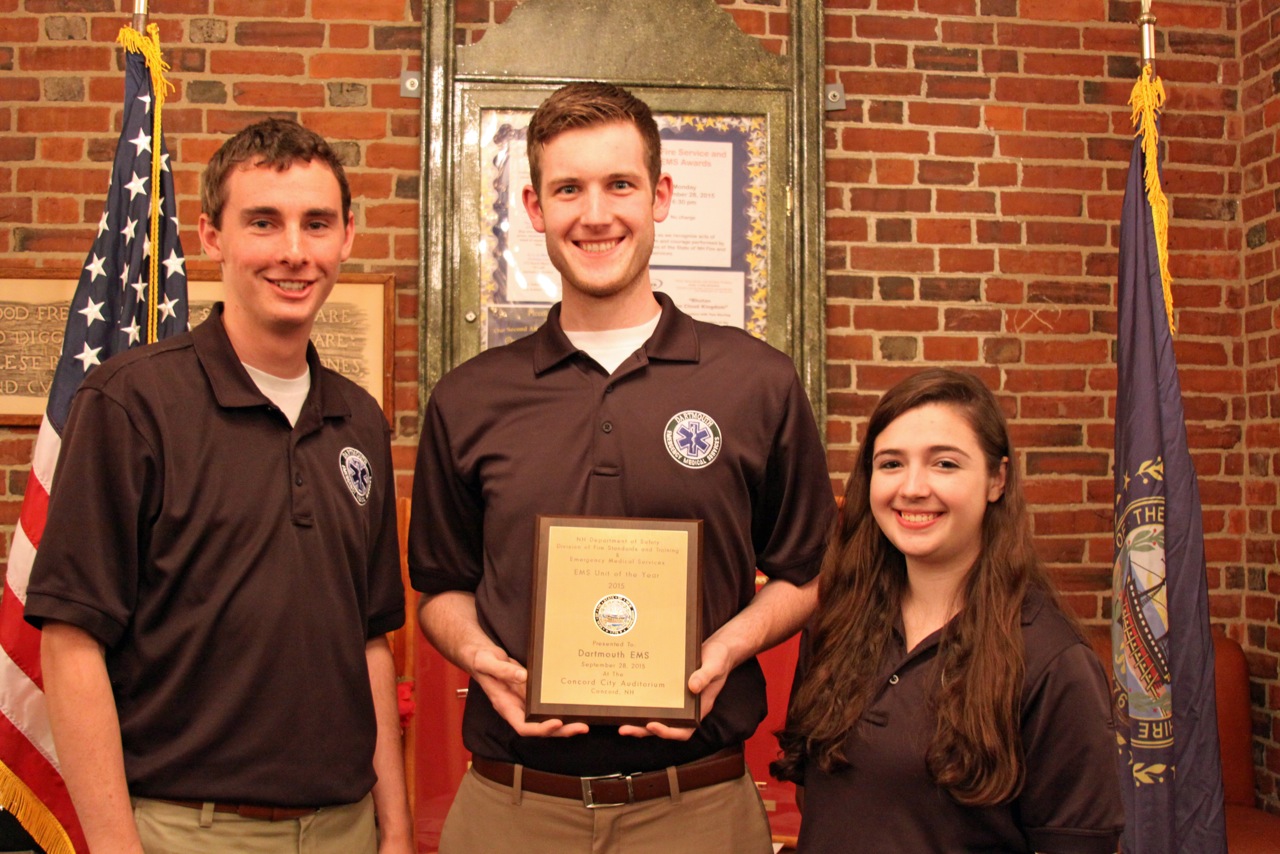 Dartmouth EMS leaders received the award in person yesterday at the Concord City Auditorium.
Dartmouth EMS training director Ian Speers ’17 said that everyone involved is “thrilled” about receiving the award.
“We don’t do it for the recognition, but it’s nice when something like this happens since everyone in the organization works incredibly hard,” he said.
Dartmouth EMS is a student-run volunteer organization that was founded in 1991 and has provided BLS — Basic Life Support — coverage for the College and the surrounding Hanover community since 2010, Crockatt said.
The organization works to improve the existing first response system in Hanover by working with both the Hanover Fire Department and Safety and Security to provide emergency services for the College, Crockatt said.
Dartmouth EMS provides free coverage to Dartmouth students five nights per week and many afternoons, Crockatt said. Additionally, they provide stand-by coverage for many campus events, he said.
In the past year, Dartmouth EMS responded to over 210 medical and traumatic injuries, totaling over 1,500 hours of volunteer coverage to the campus, according to the New Hampshire Department of Safety. Dartmouth EMS’ average response time is three minutes, according to EMS documents provided by Crockatt.
Dartmouth EMS has a close-knit community amongst its members, operations director Courtney Hargreaves ’16 said.
“It’s been a great support network, and it’s really helped me grow as a leader,” she said.
In addition to on-call BLS coverage, Dartmouth EMS became a certified American Heart Association Training organization this year, which allows the organization to teach CPR, automated external defibrillator and first aid classes to students, faculty, College employees and community members. In the past year, Dartmouth EMS set a new campus record by certifying nearly 500 people in their classes, according to information provided by Crockatt. The organization also offers specialty classes for its members and manages Dartmouth’s automated external defibrillators.
“Dartmouth EMS acts as a safety net for staff, faculty and students,” Speers said. “It’s a great way to expose students to EMS and hands-on medicine, which is often hard to get at a college level.”
Dartmouth EMS can expand training opportunities on campus for the College community, Speers said.
“We’re here to help out students when they’re in situations that they need medical help or any kind of support from fellow students,” Hargreaves said. “It was really exciting to be recognized for all the hard work that we do, [and] I think everyone in the organization felt the same way. We didn’t expect this and it was a great surprise.”
Past recipients of the EMS Unit of the Year award include Waterville Valley Public Safety, the Bedford Fire Department, Stewart’s Ambulance Service and Linwood Ambulance Service.
Article originally found at http://thedartmouth.com/2015/09/29/dartmouth-ems-named-unit-of-the-year-in-new-hampshire/. Photo provided by Dartmouth EMS.