By Melissa Kain
The Tufts Daily
|
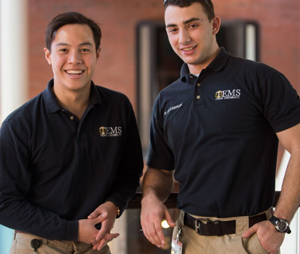
MEDFORD, Mass. — Montane Silverman and Noa Yee, members of Tufts Emergency Medical Services (TEMS), won the Richard W. Vomacka Student Speaker competition at the 22nd annual National Collegiate Emergency Medical Services Foundation (NCEMSF) conference, which took place from Feb. 27 to March 1 in Baltimore, Md.
According to Silverman, a junior who serves as the technical director of TEMS, the two of them presented about concussions, concussion management and emergency pre-hospital care at the conference, combining national data with data from Tufts into their presentation.
According to Yee, a junior who is the director of education for TEMS, preparations for the presentation began months ago.
“We had to submit [an outline] back in February for a presentation that they described as 45 minutes, as well as an abstract and intros and everything,” Yee said. “From there, they select six to eight speakers, and then those speakers who are selected … get a chance to present at this conference.”
Over 1,000 collegiate emergency medical services (EMS) students from 103 schools attended the NCEMSF conference, according to Haylee Rosenblatt, a junior who serves as the executive director of TEMS.
A large amount of work and preparation went into the presentation, which covered a variety of concussion-related information, Silverman said.
“We started … with a background on the topic, how it’s portrayed in the media and just presenting the issue as a whole,” Silverman said. They then discussed what a concussion is, how to manage one and how it manifests itself.
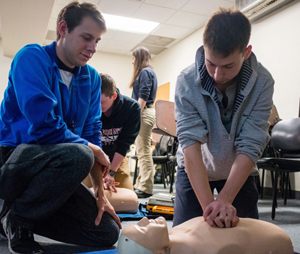 |
| Members of the Tufts community participate in a TEMS CPR certification class in Jackson Hall on Saturday, March 7, 2015. TEMS has trained nearly 800 community members, earning Tufts a Heartsafe certification during the National Collegiate EMS Foundation conference in Baltimore, Md. (Image courtesy of Nicholas Pfosi / The Tufts Daily) |
Silverman and Yee also examined how colleges handle concussions, especially in sports. “We went through rules and legislation about concussions [while] tying in facts about colleges in general,” Silverman said.
Silverman added that the presentation concluded with case studies on different concussions and how they could be handled.
Yee said that Tufts Medical Director Dr. Stacey Sperling was a hugely helpful and supportive figure throughout the process.
“She was incredibly instrumental, and continues to be,” he said.
Geoff Bartlett, who serves as TEMS advisor as well as the deputy director of public and environmental safety and director of emergency management at Tufts, expressed his pride for the recent TEMS achievements.
“The conference weekend was a big weekend for TEMS,” Bartlett said. “We’re all really proud of Noa and Montane. This is actually the first time that members of TEMS had their abstract accepted. People have to compete for the opportunity to speak … They were the first to win this award, and we’re really thrilled … and really happy to have their hard work reflect well on TEMS and Tufts University.”
According to Bartlett, Tufts also recently received HEARTSafe Campus designation, which TEMS helped earn. In order to receive this designation, at least five percent of the campus population needs to be trained in cardiopulmonary resuscitation (CPR), Bartlettsaid. A short video that teaches hands-only CPR is offered on the TEMS website for any students who wish to learn.
“We are trying to provide people, in a way that’s quick and accessible to a rescuer, the basic skills to be able to render aid in a medical emergency,” Bartlett said. “The goal of all of these efforts and the HEARTSafe program is to strengthen … the chain of survival: The notion that in order for someone to survive from an out-of-hospital cardiac emergency, there are certain steps that need to occur, and they all need to occur relatively quickly.”
Nikki Margaretos, a first-year student and member of TEMS, also expressed her enthusiasm over Tufts’ recent HEARTSafedesignation.
“I think this is huge for Tufts because it shows that our community … is committed to making the campus a safer place, and I think that going forward, it’s going to be really exciting to see how many members of our campus we can get certified in CPR,” Margaretossaid.
Montane Silverman and Noa Yee, members of Tufts Emergency Medical Services (TEMS), won the Richard W. Vomacka Student Speaker competition at the 22nd annual National Collegiate Emergency Medical Services Foundation (NCEMSF) conference, which took place from Feb. 27 to March 1 in Baltimore, Md.
According to Silverman, a junior who serves as the technical director of TEMS, the two of them presented about concussions, concussion management and emergency pre-hospital care at the conference, combining national data with data from Tufts into their presentation.
According to Yee, a junior who is the director of education for TEMS, preparations for the presentation began months ago.
“We had to submit [an outline] back in February for a presentation that they described as 45 minutes, as well as an abstract and intros and everything,” Yee said. “From there, they select six to eight speakers, and then those speakers who are selected … get a chance to present at this conference.”
Over 1,000 collegiate emergency medical services (EMS) students from 103 schools attended the NCEMSF conference, according to Haylee Rosenblatt, a junior who serves as the executive director of TEMS.
A large amount of work and preparation went into the presentation, which covered a variety of concussion-related information, Silverman said.
“We started … with a background on the topic, how it’s portrayed in the media and just presenting the issue as a whole,” Silverman said. They then discussed what a concussion is, how to manage one and how it manifests itself.
Silverman and Yee also examined how colleges handle concussions, especially in sports. “We went through rules and legislation about concussions [while] tying in facts about colleges in general,” Silverman said.
Silverman added that the presentation concluded with case studies on different concussions and how they could be handled.
Yee said that Tufts Medical Director Dr. Stacey Sperling was a hugely helpful and supportive figure throughout the process.
“She was incredibly instrumental, and continues to be,” he said.
Geoff Bartlett, who serves as TEMS advisor as well as the deputy director of public and environmental safety and director of emergency management at Tufts, expressed his pride for the recent TEMS achievements.
“The conference weekend was a big weekend for TEMS,” Bartlett said. “We’re all really proud of Noa and Montane. This is actually the first time that members of TEMS had their abstract accepted. People have to compete for the opportunity to speak … They were the first to win this award, and we’re really thrilled … and really happy to have their hard work reflect well on TEMS and Tufts University.”
According to Bartlett, Tufts also recently received HEARTSafe Campus designation, which TEMS helped earn. In order to receive this designation, at least five percent of the campus population needs to be trained in cardiopulmonary resuscitation (CPR), Bartlett said. A short video that teaches hands-only CPR is offered on the TEMS website for any students who wish to learn.
“We are trying to provide people, in a way that’s quick and accessible to a rescuer, the basic skills to be able to render aid in a medical emergency,” Bartlett said. “The goal of all of these efforts and the HEARTSafe program is to strengthen … the chain of survival: The notion that in order for someone to survive from an out-of-hospital cardiac emergency, there are certain steps that need to occur, and they all need to occur relatively quickly.”
Nikki Margaretos, a first-year student and member of TEMS, also expressed her enthusiasm over Tufts’ recent HEARTSafe designation.
“I think this is huge for Tufts because it shows that our community … is committed to making the campus a safer place, and I think that going forward, it’s going to be really exciting to see how many members of our campus we can get certified in CPR,” Margaretos said.
This article was originally posted at http://tuftsdaily.com/news/2015/03/09/tems-members-win-speaker-competition-ems-conference/.
By:Beth Maiman
USA Today College
College can come with its daily dose of stress for many students. Now imagine in the midst of class or a social gathering being called to assist someone in a medical emergency. For the 46 students who are a part of Tufts University Emergency Medical Service, also know as TEMS, this is a reality.
"When people call 911 they are really scared and they are in a bad situation and I think it is great to have people who they know and people they are comfortable with – you know their peers coming to help them," said current TEMS president and Tufts senior Ayal Pierce.
TEMS is a state licensed Emergency Medicine organization that is open 24/7 and has serviced the Tufts community since 1985.
The program is similar to many student-run emergency medical services that assist their college communities and TEMS is one of about 250 programs that are part of the National Collegiate Emergency Medical Services Foundation.
For many of the TEMS members, being a part of the team is a great way to launch their future careers in the medical field. More than half of their members are pre-med majors. The outside the classroom experience, training and education gives students a great opportunity to learn, says Geoffrey Barlett, director of emergency management.
In order to join TEMS, one must be a certified emergency medical technician (EMT). An applicant needs to be CPR certified as well and go through addition training sessions put on by the program. Members attend monthly lectures on emergency medicine topics given by Medical Director Dr. Stacey Sperling.
"For the entire time they are on TEMS they are doing extra, more advanced, more sophisticated learning which they then bring back to the EM (emergency medicine) students and they help teach," Sperling said.
There are three people on shift at a time. Shifts are spilt up into day and night hours, so most members take about four shifts a month and more experienced members sometimes work 10-15 shifts. The team travels in a truck that is equipped with all of the same equipment a basic life support ambulance would.
"It's a great way to get involved in the community," said Tufts junior and TEMS member Haylee Rosenblatt. "People will recognize and wave at the truck as we drive by."
For those interested in going into medicine, TEMS provides one way for students to earn volunteer hours. Applications for medical schools or other graduate programs in health care often require prospective students to have volunteer hours. According to the Princeton Review, applicants should aim to hold a volunteer or paid position for at least six months as a way to stand out in the admission process of medical school.
"It's an added perk completely," says Pierce about the volunteer hours. "But, in our application process we try to see if the people who are applying to TEMS are doing it for the love of EMS and not for the love of just putting it on their resume."
Even for students not planning on going into medicine, TEMS has something to offer as well.
"I think some of the things that are really important for the students are the leadership opportunities," says Bartlett. "The organizational skills – some might be very basic like how to run a meeting. These are skills that they get to develop first hand by participating in TEMS and that they are going to be able to carry into any number of different professional careers that they might pursue. It's not just about people that want to pursue is medical or health care – some do it because they enjoy it and bring what they learn into other fields."
For some students TEMS is an accurate portrayal of what to expect in emergency medicine.
"I think the services that the TEMS kids provide are pretty much the same services that any medical emergency service provides. It is a college campus so we see a very restrictive age group, but the problems that we see are the general problems in emergency medicine," Sperling says. "I think the only time it becomes a little different is that they may get called to someone they know, but I think the kids that are in TEMS handle that very well. They do a very good job of respecting privacy and being very careful about HIPPA regulations."
Pierce echoed the importance of professionalism when working with TEMS and stated that all of their patients have expressed that they like the way TEMS conducts themselves and feel confident with the provided care. Pierce says the chance to work with and also to help fellow peers does add an interesting element to the program.
"You definitely have to be careful about not talking about patients. Privacy definitely applies to us," says Rosenblatt. "So I can't go home and talk to my roommate about a call or relay any information, so that is sort of why we have each other for a support system if anything gets too difficult."
Since TEMS makes sure there is always a more experienced person on shifts, one of the obstacles they face is making sure a senior, or more experienced member, is available. That can become hard when students have other activities and with the grueling 24/7 hours of the program. When that occurs sometimes graduates will come back and help in what they like to call a "celebrity shift."
"I remember the first time I had a call – you are really happy that there is someone there who has been there for a while and can help you if something goes wrong," says Pierce.
Pierce adds that another obstacle is making sure there is continuity because people are turning over really fast and to make sure the information is being passed down to the next generation.
"It is a challenged trying to cultivate skills in a group that you know you are probably limited to four years or less – if we are lucky a few members have come certified," said Bartlett.
Even with the juggling of school, a social life and TEMS both Pierce and Rosenblatt say the experience has made proven their passion for medicine and helped solidify that a career in medicine is what they really hope to aspire to.
"We hope that their experience in volunteerism, community service and TEMS helps them to prepare to do really altruistic things that help them in their careers and their lives," says Bartlett.
Beth Maiman is a senior at University of Oregon.