By ANNIE M. GOLDSMITH
The Crimson
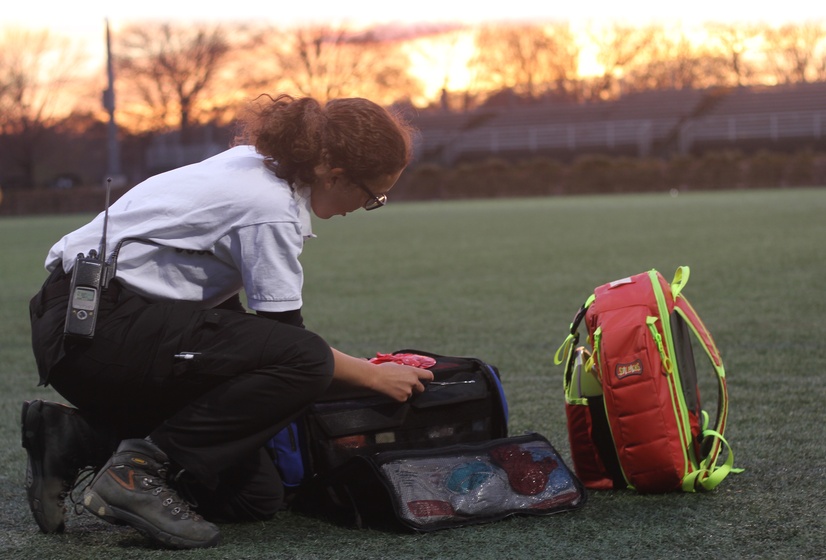
During the average week, the EMTs monitor between one and five intramural sports games per night and one or two parties per night on weekends.
“I always wanted to be prepared for that ‘what if?’ situation. I wanted to be the guy that could walk up to the car crash and do something,” Evan R. Komorowski ’18, the operations chief of Crimson Emergency Medical Service (EMS), says.
He sits at a round table in the EMS “space,” a few large rooms on the sixth floor of the Smith Campus Center. Its walls display posters with CPR instructions, assorted flyers and informational handouts, as well as photographs of smiling student emergency medical technicians (EMTs). Next to him sits Lethu A. Ntshinga ’18, the chief of Crimson EMS, and Danielle A. Seda ’19, the service chief.
Founded five years ago, Crimson EMS trains student EMTs to monitor campus events big and small and act as liaisons between the University Police Department, the University Health Services, and students at the university. Each EMT goes through rigorous training and must complete service requirements to maintain their position.
During the average week, the EMTs monitor between one and five intramural sports games per night and one or two parties per night on weekends. “A large part of what we do is reassuring people that they’re safe here because we’re there,” Ntshinga says.
“Our role is also providing relief to students, in the sense that knowing there are skilled medical professionals here allows them to maybe enjoy themselves a little bit more,” Ntshinga says. “Even on nights when we don’t have patients, we still feel as though we’re serving a purpose.”
This sense of reassurance for the student body is not without sacrifices for the EMTs, who monitor parties and events “until people decide that the end of the party has come,” says Ntshinga. Komorowski and Seda exchange knowing glances, then nod. Clearly “the end of the party” is often quite flexible. Ntshinga says EMTs often bring homework along, as it’s not uncommon for a party shift to last up to five hours.
Even though the EMTs must stay on the sidelines, Ntshinga enjoys monitoring parties. “The shifts that we get to be on at night is the time when people are the most relaxed and the happiest and enjoying their college experiences the most.” Ntshinga says, smiling. She rests her hands on her closed laptop, decorated with a sticker that reads: “People Over PSets.”
Ntshinga likes to “watch my classmates have a great time and to see some of my friends—and see them when they’re not freaking out about a test or the project that’s due,” she explains. “Just taking a moment to take care of their social well-being.”
But serving as a collegiate EMT comes with unique challenges. “The issue is that your patients are your classmates. And that’s something you don’t get in a traditional 911 transporting service—you pick someone up and then you never see them again,” Komorowski explains. “Meanwhile, here, I have had people get very irate with me … and then 8 hours later I’m eating lunch two seats away from them in the dining hall.”
Despite these challenges, Komorowski says he appreciates the skills he has gained through his experience as an EMT. “When you find someone unconscious on the floor of a bathroom, a lot of people just panic,” he says. “But now, going through the training, you get the skillset to deal with that sort of emergency.”
The student EMTs also learn skills beyond medical response. “In EMS in general, there’s no room for self-doubt a lot of the time,” Ntshinga says. “You really need to look at yourself as the authority and trust in your own judgment.”
This article originally appeared at: https://www.thecrimson.com/article/2017/5/5/night-shift-crimson-ems/
By Eliza M. Nguyen and Jane Seo
CRIMSON STAFF WRITERS
Thirteen new student organizations, whose missions range from fostering a vibrant social scene to facilitating emergency medical services, were approved for recognition by the Committee on Student Life last Thursday. The 13 were among the 30 groups that sought official recognition from the College. Seven applications were deferred, and eight were denied.
Team HYPE of Harvard College will make its debut on campus this fall. The organization’s mission is to enhance the school’s social scene by creating fun and inclusive environments for undergraduates, according to its founder and captain Beau M. Feeny ’13.
“It will serve as a central body to augment social experiences at Harvard,” he said.
The club will provide event and publicity consulting services to other student organizations. Feeny said that TeamHYPE will attempt to generate enthusiasm at campus-wide events, such as Yardfest and athletic events.
CrimsonEMS, a new student-run ambulance organization, will facilitate a heavily subsidized Emergency MedicalTechnician-Basic training course at Harvard. It will also connect students interested in working aboard anambulance with MIT-EMS until the group is able to establish a campus ambulance service.
“We hope to offer real world medical applications in college for all students, and this will be the best way tounderstand what emergency services is like,” said CrimsonEMS Chair Elliot J. Stein ’13.
Stein said that the benefits of recognition include the club’s ability to advertise to the general student population,apply for UC grants, and have a table at the student activities fair.
Members of The Nostalgics—Harvard’s first and only motown and soul band that has been performing duringcampus events since its founding in 2010—cited similar reasons for applying for recognition.
Charles G. Gertler ’13, one of three founders of The Nostalgics, said that recognition will give the band accessto resources reserved for official student organizations such as grant money, rehearsal space, and the activitiesfair where he said he hoped to recruit new members.
Benjamin Naddaff-Hafrey ’13, another founding member, said they were concerned the band, whosemembership is mostly comprised of juniors, might dissolve following the graduation of the Class of 2013. Gertlerand Naddaff-Hafrey said that recognition will allow them to institutionalize the group and ensure its future afterthey leave Harvard next May.
“It lets us perpetuate what the band stands for and what is unique to The Nostalgics rather than what is unique tothe founding members,” Naddaff-Hafrey said.
While the OSL administers the College’s recognition process for new organizations, the decision is made bystudents on the Undergraduate Council, faculty and administrators.
Each semester, the Office of Student Life reviews proposal packets that have been submitted by studentsinterested in creating a new student organization, according to its website.
There are currently more than 400 recognized student groups on campus, according to Assistant Dean ofHarvard College for Student Life David R. Friedrich.
—Staff writer Eliza M. Nguyen can be reached at
—Staff writer Jane Seo can ben reached at