Consider, for a minute, what happens when there’s a 9-1-1 call on campus for a medical emergency. Towson University police don’t have an ambulance, and Towson doesn’t have a dedicated fire service.
So, if someone on campus were having a heart attack and called for an ambulance, they’d be trying to get help from the same set of ambulances as the rest of northern Baltimore County.
“It can take up to 20, 30 minutes or more for an ambulance to arrive,” sophomore Justin Joffe said. “But [a group of students] could all respond within a matter of minutes.”
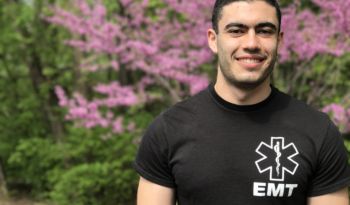
Joffe, a health sciences major, is part of a group of students working to start a dedicated EMT service on campus.
EMT, or emergency medical technician, is a health professional trained in basic life support – like CPR or helping a patient respond to an allergic reaction or asthma attack.
Paramedics (an EMT and a paramedic are not the same thing, despite popular belief) go through longer training, and are able to, for example, start an IV for a patient or administer medication.
Joffe wants to start Towson University Emergency Medical Services, a student volunteer organization that would operate under the Health Center and TUPD. Currently, Joffe said there are 12 interested and EMT-certified students, including himself.
“We’re looking to just get our hands back on service,” Joffe said, because it’s difficult to work as an EMT during the academic semesters.
If Joffe and the administration are able to implement the plan, it would work sort of like this:
- A 9-1-1 call from campus goes out. A TUPD dispatcher answers the call and assesses that it’s a medical emergency.
- The dispatcher radios an on-call member of TUEMS, who is able to respond to the scene.
- The student responder (who’s a certified EMT) arrives and provides whatever support possible to the patient until an ambulance can arrive and transfer the patient.
“We can’t transport, but it’s a quick response,” Joffe said.
Joffe said that members of the administration have been supportive, it’s just taking a while to implement the system.
“I think it’s a fantastic idea that’s a lot more complex in terms of implementation than one would think,” Vice President for Student Affairs Deb Moriarty said. “Because there are lots of liability concerns, we just have to make sure we have all the right support systems in place.”
National Collegiate Emergency Medical Services Foundation is a nationwide nonprofit organization that works to foster the development of campus EMS groups.
According to the group’s website, there are over 250 registered campus EMS groups The closest ones to Towson are Johns Hopkins UniversityUniversity of Maryland, Baltimore County
Ultimately, Joffe said he wants the program to be about “students helping students,” so that a student who is experiencing some kind of emergency on campus might feel more comfortable calling for help.
“I think it’s a great program,” Moriarty said. “I think it could be an asset for campus.”