By Ron Medvescek Arizona Daily Star
The University of Arizona is home to more than five dozen first responders who answer calls for help on campus .
From their squad room in the basement of Kaibab Residence Hall, UA’s University Emergency Medical Service responds to more than 600 emergency calls during the school year, assisting students, staff and visitors who are injured or need medical services.
The UEMS staff consists of three chiefs, three captains and more than 50 emergency medical technicians and first responders. All of them are undergraduates.
They work six- or 12-hour shifts, staffing 24/7 during the school year with breaks on holidays and over the summer.
“As EMTs we operate at the BLS level (basic life support), same as Southwest Ambulance and the majority of the Tucson Fire Department,” said Executive Chief Zach Saxman.
Tucson Fire dispatches paramedics who are certified in advanced life support. UEMS squads are dispatched by UA Police and respond simultaneously to campus 911 calls .
In the fall, the service equipped a Chevrolet Suburban with emergency lights and sirens, but it’s awaiting state authorization to use them while headed to “Code 3” emergency calls.
The squads also use customized golf carts to cover special events around campus such as the Tucson Festival of Books, Spring Fling and graduation ceremonies.
Originally posted at http://tucson.com/news/local/education/college/student-emergency-service-answers-campus-calls/article_498a30b7-4c3b-5ae1-8deb-42ab0733fe85.html.
Tens of thousands of students back on the University of Arizona campus means more calls for help to first responders.
In 60 cases since August 19 this year, the ones answering those calls are fellow students, according to University EMS Chief Zach Saxman.
“It’s probably been one of our busiest years yet,” he said.
The state and nationally certified organization handled 680 calls last year, with the most in one month being 75 in September, according to Saxman.
“It's almost baffling that were able to do it, but having the dedicated group of men and women that we do, we are able to pull it off every month,” he said.
He said the students who join University EMS provide the same level of care as any other agency in town, but the campus team better connects to the community it serves.
“It's more of a local one on one kind of service that we provide,” said Saxman. “We understand the issues that are going on here being students ourselves, and that's what we want to be able to continue with.”
Saxman’s seen the organization grow from April 2012 when founding members rode bicycles to emergencies. Now, a team of 50 students cover shifts around the clock. The bikes were upgraded to a loaner golf cart, which has now been replaced with a permanent, larger cart. Soon, that’ll be the backup ride to the organization’s recently acquired Suburban.
“A lot of people see us as just students, when in reality were actually certified professionals,” said Assistant Chief Logan Ternes.
Ternes said he applied to University EMS after he learned that anyone working on an ambulance in Arizona has to be at least 21 years old. No ambulance on campus, means no restrictions for an aspiring medical professional.
“I’m lucky in that I knew what I wanted to do since I high school,” he said.
Assistant Chief Nikki Taylor wasn’t as sure as Ternes when she joined a year and a half ago. She said she signed up at the suggestion of a friend, and was hooked after her first call.
“I just fell in love with it and I worked crazy hours just because I wanted to come back,” said Taylor.
She started as a first responder, with only CPR skills, but she trained like anyone else who wants to do more for the organization and the campus community. Taylor and her fellow supervisors agree that dedicating so much time to University EMS is a lesson in time management, but a minute is never wasted. Any lull between emergencies provides time to catch up on school work, because members of University EMS can’t slack on
their grades.
“School always comes first,” said Taylor. “But this is a close second though.”
Originally found at http://www.tucsonnewsnow.com/story/29918970/busy-start-to-u-of-a-school-year-for-student-ems-team
By Eric Swedlund, University Communications
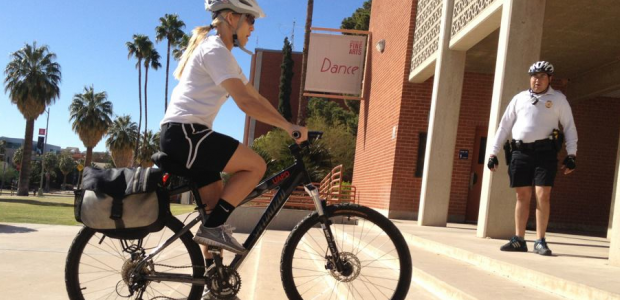
Whether it's a bicycle collision or difficulty breathing, the UA community can count on quick help from students trained and certified as EMTs.
The University of Arizona Student Emergency Medical Services, or UASEMS, group has been operational for three semesters and provides assistance in medical emergencies. Its leaders emphasize thorough training and certification.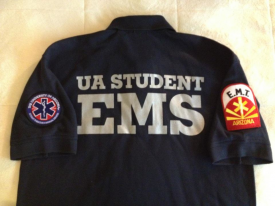
"We're students at the UA who happen to be EMTs. We're not student EMTs," says Derek Smith, manager of UA Student Emergency Medical Services and a non-degree-seeking graduate student.
When Brandon Murphy arrived at the UA three years ago, he didn't find any options for students to work in EMS on campus. He met up with two other students – who've since graduated – to begin brainstorming a program that students could run. They looked at other universities that have student EMS programs and modeled a club after the best practices they found around the country. It took two years to work through the administration and risk management officials, but they were able to start as a club with ASUA funding and began responding in spring 2012.
UASEMS switched to funding from the student service fee and began expanding hours in fall 2012. As the fall progressed, the group did too, taking on additional days until they were operating from 6 p.m. to 6 a.m. seven days a week.
UASEMS this year was the sole EMS provider at the Tucson Festival of Books, saving the festival $4,000 by not using the Tucson Fire Department. UASEMS also works stand-by at Spring Fling, football games and tailgating and when requested for special events, like the Susan G. Komen Race For The Cure.
"Anything that occurs on campus, we can be there," Murphy says. "Our members do get put into emergencies where they're the only person there, so we make sure they're held to the same certification. We weren't going to settle for a CPR certification or anything else. We make sure everyone has state certification."
UASEMS finished the semester with 32 student members, most of whom are certified Emergency Medical Technicians, with the same Arizona training and certification as a Southwest Basic Life Support Ambulance. Two EMTs staff each 12-hour shift, sometimes along with an additional Certified First Responder, and typically respond to at least two calls for service. On its busiest day, UASEMS responded to 12 calls in a 24-hour period.
Common calls for service deal with fall victims, injuries from pedestrian, bicycle or vehicle collisions and respiratory distress.
"It's part of our emergency mission to provide a quick, rapid response and be the first to provide care until further medical care arrives," Murphy says.
By checking vital signs and reporting to paramedics, the student EMTs can eliminate a step and save valuable time if a patient needs to be taken to a hospital.
"There are calls where we take the blood pressure while waiting for TFD and give the information right to them so they can load and go. They appreciate it," Murphy says.
Many students join out of an interest in a future medical career, some have even gone on to medical school already, while others are considering EMT as a career. Interest is growing; the group has received 80 applications since the fall that they haven't been able to accept.They're hoping to take on as many as 10 in the fall and hope to expand to providing EMS service around the clock, seven days as week.
UASEMS has a golf cart and two bicycles, all equipped with emergency gear. UAPD ride-alongs are a mandatory part of the orientation, which includes 20 hours of vigorous bike training and instruction on bloodborne pathogens and health privacy laws. The members participate in monthly continuing education courses and perform mock drills during the week.
"It's real-life, in-the-field experience they can't get shadowing somebody in a hospital," says Murphy, a junior in communications from New Jersey. "Here, you're set to a standard and you have a responsibility. That is your patient until further medical attention arrives."