BY RICHARD JAMESLEY, MATTHEW PALMISANO, ROB LAWRENCE
EMS World.com
University-based EMS systems have existed for decades. There are currently 243 collegiate-based EMS systems in the U.S. and 16 more in Canada.They are represented by the National Collegiate EMS Foundation.
In Virginia, the University of Richmond, recently declared by U.S. News & World Report the No. 1 up-and-coming liberal arts schools in the country, has a student-led EMS group that has now completed a 15-year journey to become an efficient and effective EMS organization.
In 1998, a group of students led by undergraduate Patrick Oliver, an EMT, noticed that the ambulance response times to 9-1-1 calls on campus were excessively long, even in high-priority cases. The campus was split between two jurisdictions, which created dispatch uncertainty, and the constantly renovated campus roads presented a challenge to responding units unfamiliar with the university's layout. Dozens of already-qualified EMTs lived on campus, yet their skills, proximity to medical emergencies and knowledge of the campus went unutilized.
Oliver and his group seized the opportunity to remedy the situation. They established an all-student EMT group called the Spider Advanced Volunteer Emergency Rescue Squad, or SAVERS, to initiate care to patients on campus while waiting for ambulances to arrive.
During the group's infancy, its operations were anything but advanced; its responders relied on the tools and resources of university police officers.
"The extent of the communication instruments owned by SAVERS," recalls Oliver, "included two pagers to direct the on-call responders to emergency scenes. Without radios, they could not give responding units patient updates or directions around campus. The EMTs also transported themselves to emergencies, either by driving their own cars or by putting one foot in front of the other all the way across campus."
In time the program's budget expanded, and response bags were acquired, but the EMTs were still required to rely on what they could carry on their backs. "Improvise, adapt and overcome" was an often-used phrase. Through the 10th anniversary of SAVERS, responders continued to be dispatched through pagers and carried minimal equipment in small response bags.
Ultimately, however, SAVERS became affiliated with the Richmond Ambulance Authority (RAA), which is responsible for all EMS operations in the city of Richmond and frequently worked with SAVERS to treat patients on the University of Richmond campus.
In 2009, RAA, also undergoing a renaissance after it severed ties with its ambulance contractor and became a self-operated public utility model, began to fully mentor the college program. At the same time, SAVERS restyled itself as the University of Richmond Emergency Medical Services, or UREMS.
RAA's CEO, Chip Decker, played a major part in transforming the organization; as chief of a local volunteer rescue squad and an EMT instructor, two decades earlier he'd run the first EMT courses on campus—classes that ultimately led to formation of the university squad.
The partnership with RAA brought with it more advanced equipment, such as duty cell phones to replace the pagers and two-way radios to communicate with responding units and dispatch personnel.
RAA also brought guidance from its medical director, prominent emergency physician Joseph P. Ornato, MD. In 2012, growing relationships with the university police department were cemented into what has now become a seamless working partnership.
Squad Receives New Delivery
In 2013, UREMS has grown far beyond its roots. Original student leader Oliver, now an MD, recently lent his successors some support in the form of a quick response vehicle (QRV) to allow UREMS providers to respond to calls faster and carry more equipment.
"I would never be able to teach my mentors much," says Oliver. "I will never be able to give them as much as they gave me, but I can do that for others who come after me."
The 2013 Ford Escape SE with an EcoBoost engine was purchased in partnership by Oliver, the university and its police department, and was outfitted by RAA as a nontransport BLS emergency vehicle with state-mandated road safety and communications systems. A roof-mounted solar panel keeps battery-powered equipment charged without plugging in.
UREMS is currently composed of 20 student volunteers, who respond to all medical emergencies on campus while classes are in session, totaling about 10,000 hours of volunteer service each academic year. Most of these EMTs are trained in UREMS-sponsored classes, and the resources to provide such classes are another mark of the organization's success. UREMS's budget allocated by the university this year is $14,000, more than 90 times the initial fund given to SAVERS.
With a maximum four-year term for undergraduates, recruitment is a major effort, and UREMS recruiters use word of mouth, the Web and social media to attract new members. Says UREMS Operations Chief Matt Palmisano, "We attempt to target younger students so we can get more years out of them, but we encourage anyone of any college year to apply."
Members must be an EMT-B or higher in Virginia, possess CPR certification and have completed NIMS 100, 200 and 700. New recruits complete three 12-hour ambulance ride-alongs with RAA and a further 12-hour shift in which half the time is spent with a field operations supervisor and the other half in the communications center. On completion of their training, EMTs undergo a clearance process via skills evaluation, a review of SOGs and an overview of how UREMS, URPD and RAA work together.
Post clearance, new EMTs must have 17 weeks' experience and have completed their UREMS Field Training Guide Book and received call evaluations from a UREMS FTO before they are eligible to become a UREMS 1, which is UREMS lingo for AIC. Ongoing professional development maintains skill levels and currency.
UREMS continues to function as a nontransport response group, with the main priorities of initiating care and directing responding transport units to the proper locations on campus. With each new year, members and student leaders contribute more time, energy and ideas, growing a collegiate EMS organization they believe in, and the effort has clearly paid off. The continuing success of UREMS is owed to the members' constant commitment to work with the materials at hand, however limited or abundant, and push hard to build the organization one step at a time.
There is a distinct advantage to having university clubs deliver EMS first response on campuses that can be difficult to navigate and off the beaten track. The longer-term advantage of these clubs is that they are rapidly becoming an inspiration for a new generation of emergency physicians, who may eventually go on to become EMS medical directors. This is a healthy circle of life. Full-time services would do well to visit the NCEMSF website and see if there is a collegiate EMS organization in their locality. The benefits could be life changing for both patients who receive their care and the students who deliver it.
For more on UREMS, visit http://police.richmond.edu/urems/index.html.
Richard Jamesley is president of UREMS, as well as a field operations supervisor. He is a Business Administration major with a concentration in Finance and a minor in Pre-Health Studies. He is the NCEMSF's 2013 National Collegiate EMS Provider of the Year.
Matthew Palmisano is chief of operations and a field operations supervisor for UREMS. He is pursuing a double major in Leadership Studies and PPEL (Politics, Philosophy, Economics and Law), with a concentration in Economics.
Rob Lawrence is chief operating officer of the Richmond Ambulance Authority and a regular contributor to EMS World. He was recently appointed to the EMS World Editorial Advisory Board.
ALEXIS ACHEY, EMT-B, & JASON R. ROACH, NREMT-P/CCEMT-P
EMS World.com
Alexis Achey was diagnosed with type-one diabetes at the age of 7. Her pancreas is unable to produce any insulin so she must obtain insulin through injections to maintain normal blood glucose levels. She went on an insulin pump at age 9, which granted her the freedom of not having to constantly carry and use time-consuming syringes.
But over the next few years she began noticing she was becoming hypoglycemic, although at a glucose level of 38 she saw no obvious symptoms.
After researching continuous glucose monitor options as a solution, she discovered diabetic alert dogs. These dogs are able to sense fluctuations in blood glucose levels at the core of the body and are able to alert their owner to the fluctuations prior to any electronic devices, which would detect a change at the extremities. Those minutes could mean the difference between a simple correction of a dangerous glucose level—while still conscious and coherent—or activating an emergency response system. Believing an alert dog would provide a greater benefit than any electronic monitor, in February 2012 she reached out toService Dogs by Warren Retrievers, an Orange, VA-based organization specializing in service dogs, and was placed on a waiting list. Service Dogs by Warren Retrievers works has worked with more than 250 families who have either been paired with a service dog already or are on a waiting list.
In August Alexis received a call saying she'd been matched with a black male puppy, and she was asked to name the dog. The matching process was based on a survey of her lifestyle and plans for later in life that Alexis had completed earlier. By September 2012 Alexis was paired with Winston, a 3-month old black lab. When Winston arrived he already knew basic obedience and immediately began scent training specific to Alexis. Pairing the dogs with an owner at a young age allows the dog to "grow up" on their owner's scent, so the dogs are not alerting to every blood sugar outside of their owner's normal range. A high blood sugar smells fruity or sweet to Winston, while a low blood sugar smells like acetone. Over four days of scent training, Winston learned to paw Alexis's leg for a high blood sugar or nudge her leg for a low blood sugar. This differentiation in alerts allows Alexis to determine how quickly her glucose is changing and therefore how urgent treatment must be. Winston often alerts Alexis on a daily basis. Illness and stress, which are common among college students like Alexis, can have a drastic effect on blood glucose levels.
In spring 2012, Alexis took and successfully completed the Virginia EMT-Basic certification course and by fall she joined University of Richmond EMS (UREMS). In her spare time she also volunteers with Tuckahoe Volunteer Rescue Squad (TVRS). Winston has been with Alexis since she first joined UREMS and is with her 24 hours a day, even while she's on duty. Bringing a service animal into an emergency scene may not always be appropriate, so Alexis has to use her discretion—based on the type of call, time of day and information relayed from dispatch—to determine whether Winston remains at her side, in the vehicle or with a friend. She also had to sign a waiver with the university stating she assumed all responsibility for any issues that might arise with having Winston on duty with her.
As of April 2013 Winston has responded on 10 calls with Alexis. Sometimes he patiently waits at the door but on other occasions he's played a therapeutic role for anxious patients, resulting in a more calm and relaxed environment. Winston has allayed patient fears about going in an ambulance and has helped patients relax in stressful situations. He has also allowed Alexis to participate in EMS, not only taking care of her needs but also introducing a new experience to prehospital EMS on the University of Richmond campus. Because Winston is always watching out for Alexis, she can focus all of her attention on serving others rather than maintaining a vigilant watch on her own medical needs.
Alexis Achey is an EMT-B with University of Richmond (VA) EMS and a volunteer with Tuckahoe Volunteer Rescue Squad. She will graduate from the University of Richmond in 2014 with bachelor of science degrees in physics and chemistry.
Jason R. Roach, NREMT-P/CCEMT-P, is a captain and field operations supervisor for Richmond Ambulance Authority in Richmond, VA.
Fall 2012 Newsletter from University of Richmond EMS
Source: Richmond Ambulance Authority
Affiliated with Richmond Ambulance Authority since 2009, student EMTs previously answered calls on foot, by bicycle or in a personal vehicle
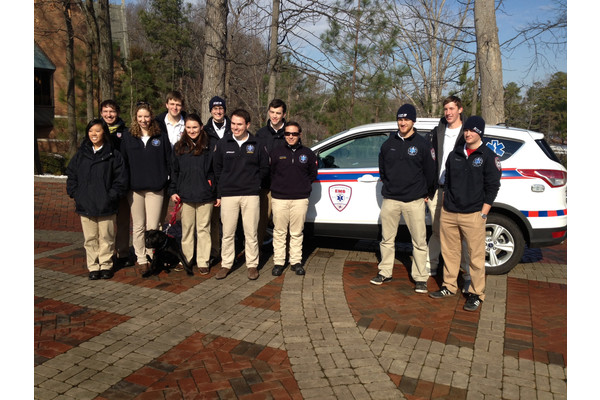
A new four-wheel drive vehicle will enable student emergency medical technicians (EMTs) serving University of Richmond’s campus to respond rapidly to emergencies.
University of Richmond Emergency Medical Services (UREMS), a student emergency medical technician program, has acquired a 2013 Ford Escape Ecoboost SE, fully stocked with first response equipment and outfitted with lights, siren and exterior identification.
Affiliated with the Richmond Ambulance Authority (RAA) since 2009, student EMTs previously answered calls on foot, by bicycle or in a personal vehicle, carrying limited equipment in small response bags.
Eleven of UREMS’ 16 members have completed the Emergency Vehicle Operations Course and certification required to drive the vehicle. Seven with the most experience will be drivers until the other four certified members gain at least six months of experience in the field.
Richmond Ambulance Authority outfitted the SUV as a basic life support, non-transport emergency vehicle with state-mandated road safety and communications systems. Roof-mounted solar panels will keep battery-powered equipment, such as a heart monitor and laptop computer, continuously charged without being plugged in.
UREMS received additional support in acquiring the vehicle from the university’s public safety division, student activities office and former Richmond student EMT and UREMS founder Patrick Oliver, MD.
Student EMTs train with RAA and are issued RAA/UR identification, UREMS uniforms, pagers, cell phones and portable radios that allow them to contact local emergency responders directly. When RAA receives a 9-1-1 call from campus, it dispatches UREMS EMTs to provide patient care until an ambulance arrives.
The student responders work in teams of two and are on call 24/7 during the academic year.They answer an average of two to three calls a week and have treated students, faculty and visitors for everything from heart problems and seizures to traffic accident injuries. Student EMTs began serving the campus in 1998, but affiliated fully with RAA four years ago. They receive additional sponsorship from the university.
"Having an emergency response vehicle with state-of-the-art equipment will provide a timely response to reach patients on campus and increase our treatment options until an ambulance arrives on scene," says Richard Jamesley, president of UREMS.
"There has been a surge of student interest in the program since Chip Decker became CEO of the Richmond Ambulance Authority and helped structure a more formalized EMS program on campus," says University Police Capt. Beth Simonds. "The training and equipment are becoming more advanced each year, and we can now stage our own emergency response vehicle at campus events to provide even faster coverage. It benefits the entire community."
Decker said that UREMS not only provides quick response to patients on campus while an ambulance is en route, but also is a wonderful learning opportunity for the student EMTs.
"These students basically have all the privileges that RAA EMTs do without the paycheck.They receive classroom training from RAA personnel and also ride with our crews in the field.It is great exposure for these undergraduates, many of whom are interested in medical careers, and an invaluable lesson in leadership," says Decker.
Jamesley said the student medics, "enjoy helping our fellow students and others who find themselves in need of medical assistance on campus, and we can now provide a swift response every time."
BY RYANN DANNELLY
Collegian Reporter
Student leaders discussed new ideas for collaborating among on-campus organizations and heightened communication between the organizations and the study body during the second Student Leader Town Hall Meeting.
The Second Student Leader Town Hall Meeting was held from 6 to 7:30 p.m. Feb. 2 in the Keller Hall Reception Room.
The first Student Leader Town Hall Meeting occurred last semester and focused on different ways of improving campus life. "During the first meeting we ranked what we thought the most pressing issues that needed to be addressed in relationship to the students and the organizations on campus," Joey Greener, the vice president of Campus Activity Board said. "In the end it was decided that we needed to focus on communication and collaboration."
Student leaders from different organizations were invited to the meeting to discuss and give their input into ways of improving the communication and collaboration.
"The positive feedback we received during the first meeting helped us to create the second meeting with our focus this time on networking around campus as a way to reach out to the different student organizations," said Kate Fleischer, chairwoman of the Senate for WCGA.
One example of an organization in which the student leaders discussed new collaboration and communication was Residence Assistants roles involving the students compared to the role of Orientation Advisers. "There is not a natural transition from the Orientation Advisers to the Residence Assistants," Phylicia Hoyt, the chairwomen of student affairs explained.
OAs are able to spend quality time with the residents in their groups and are therefore usually the ones that the freshman converse with and ask questions to, Hoyt said. The RAs are usually distanced from the freshman because they are not given that same opportunity to bond and get to know the people living near them, Hoyt said.
"This mentality creates an unnecessary animosity toward RAs for most students’ remaining college experience," Hoyt said. "Instead of using their RAs as a resource and mentor, like students should, students remain distant from their RAs because they only associate them with writing students up." Hoyt said that if RAs were more involved in orientation, the stigma against them could disappear.
The RAs, however, are not the only organization on campus who could benefit from better communication and collaboration.
"If communication between the different organizations on campus increased, we could decrease the excessive number of repetitive events that different organizations create by combining them," Greener said. "Take, for example, the large number of small blood drives that occur on our campus yearly. If we combined all of them into one massive blood drive, I think the results would be better for effective for everyone."
The University of Richmond Emergency Medical Services could benefit from an increase in communication with the students and new collaboration with other organizations, Matthew Palmisano, the supervisor and vice president of operations for the UR EMS said.
"A lot of students don’t understand what our amnesty policy implies and how it can help them," Palmisano said. "People are afraid to call us if they’ve been heavily drinking for fear of getting in trouble. If they only knew that our amnesty policy protects them from getting in trouble, more people might call and we would be able to help more students in need."
Not only does Palmisano want better communication with the students in order for them to understand all that the UR EMS does, but he also wants to collaborate with different organizations as well. He siad that working closer with OAs and RAs could help to increase the student populations understanding of what the EMS does and keep more students from reaching the point of intoxication where help is needed.
The UR EMS also wants to create a blood drive this year, Palmisano said. "The campus hosts many blood drives yearly," Palmisano said. "Instead of just creating a new blood drive for the EMS, I think it would be more beneficial if we joined with one of the other blood drives."
With all the ideas and plans for new collaboration, Anthony Crenshaw, the assistant director for student organizations and leadership development gathered all of the student leaders and discussed ways of improving communicating with the student body.
"I hear around campus the same two ideas repeated over and over again," Crenshaw said. "People either tell me that nothing ever happens on this campus, or that they don’t know how to meet people and get involved."
In order to solve both of those problems, as well as the problems of communication and collaboration, Crenshaw has created a Google calendar with every event that student organizations give him that can be accessed through the Student Activities website. However, there are a few things that Crenshaw and the student leaders argued that needed to be addressed with this calendar.
As of now, the only way that organizations and groups can add their events to the calendar is by emailing a Student Activities worker and having the worker adding the event, Greener said.
"We need some way to make this calendar easier to add events to and more accessible to the student population so that everyone will have a way of knowing what is occurring on campus," Greener said. "If we can turn this calendar into the fully functioning calendar that we have in mind, we can also help the process of helping organizations on campus to collaborate because they will be able to locate, in one easy spot, what everyone else is doing and see if they are planning something similar."
With hope for an updated Student Activities calendar and the awareness of the need for collaboration between the different organizations and communication with the student population, the student leaders seem more optimistic, Fleischer said.
"I think we should see the change and progress that we want in the communication and collaboration between the students and the different organizations now that we have had our second meeting," Greener said. "We have the theory down now of what needs to be addressed; now we just need to put that into practice."