BY EMILY HERNANDEZ
The Daily Texan
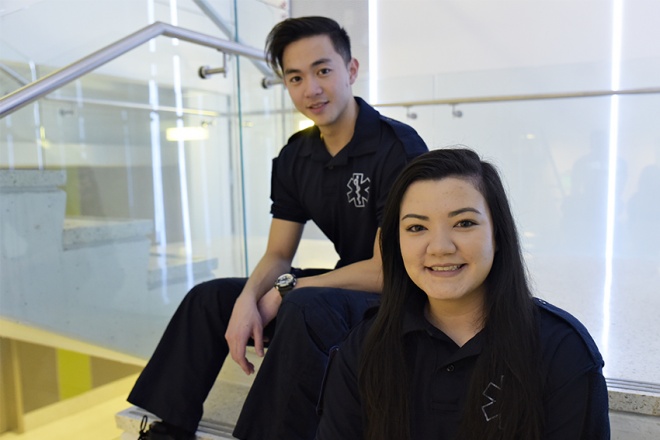
Students may see the establishment of Longhorn Emergency Medical Services as a campus first response organization. Student Body President Colton Becker said in a campus-wide email that a new proposal had been submitted to authorities both on and off campus.
Longhorn EMS chief Anthony Liu said the organization didn’t leave enough room for University input in their previous proposal, so this time they left their proposal flexible to meet University needs.
“This is a need on campus; it’s not just a perk,” exercise science senior Liu said. “We want to give the University options to put whatever they want within the proposal to make it happen.”
Longhorn EMS is a registered student organization with 40 certified emergency medical technicians, though students do not have to be certified as an EMT to join.
Nutritional sciences senior Becker said he decided to promise the establishment of a campus first response organization in his presidential campaign last spring following the death of freshman Harrison Brown in May 2017.
“Harrison Brown was a friend and mentee of mine, and I remember the day he passed away,” Becker said. “When the stabbing occurred, the ambulance couldn’t get to the scene because they were blocked off at the check station in front of the PCL … that’s when I really started paying attention to EMS response time on campus.”
The University initially had concerns regarding the safety of student EMTs responding to emergencies, but Longhorn EMS captain Jordyn Chang said the EMTs accept the risks.
“Once we wear the badge, we assume responsibility,” said Chang, a health and society senior. “If we aren’t working on campus, most of our EMTs do work off campus as EMTs, and they assume that responsibility every day.”
The issues of campus inaccessibility and insufficient response times are partially why Mark Escott, EMS system medial director for the City of Austin and Travis County, is helping Longhorn EMS with their first response organization goal.
More than 150 universities across the world have some sort of campus emergency system in place, and having this resource helps prepare not only the student EMTs, but also the community as a whole in an emergency, Escott said.
UT-Dallas became the only school in the UT System to have a campus first response organization when it established University Emergency Medical Response in 2017. University EMR chief Scott Bell said UEMR can respond to critical and minor calls within two minutes, which can save lives and put City emergency vehicles back into service faster.
“We deal with a lot of life-threatening things and we also deal with a lot of non-life-threatening things,” said Bell, a neuroscience junior at UTD. “Coupling those together, we’re really able to have an all-encompassing effect on campus safety.”
Escott said he currently provides mentorship to Longhorn EMS and has offered the group his oversight as a physician if they become an official program of the state.
“Any one of these students could be employed by Austin-Travis County EMS and be paid to do this job today,” Escott said. “But we have professionals who are students who are willing to do this for free, and I think we ought to provide them that opportunity. It’s worth the risk. It’s worth the financial investment to provide this layer of safety to the campus community.”
Originally published at http://dailytexanonline.com/2019/01/29/longhorn-ems-submits-second-proposal-to-university-aims-to-save-lives-on-campus
By Alyssa Goard
KXAN TV (NBC)
AUSTIN (KXAN) — UT Austin Students are trying to rally support — both from their peers and from the university administration — for dedicated, on-campus emergency services. Notably, they want trained student volunteers to staff this service, responding on bikes and by foot to give immediate care when a crisis happens.
Jason Taper, the campus safety policy co-director for UT Student Government, was on campus back in May of 2017 when the deadly stabbing attack broke out on campus.
"It was terrifying," he recalled.
"Really, we just want to be proactive I guess and make sure that when the worst case happens that we're ready," Taper said, referring to the proposal for on-campus EMS student government has now sent to Campus Safety.
He explained that this emergency medical service wouldn't have students transporting people in ambulances, but rather getting to injured people on campus immediately after they are hurt. Taper got involved in this effort after an EMT-trained friend of his struck out with a previous effort to get an on-campus EMS system.
"It is something that affects literally the life of every student on campus, so I think it's a very important thing to be talking about," Taper said.
While the campus is bike and pedestrian friendly, Taper noted he has seen cars and even ambulances stalled at some of the barriers and roadblocks made to ease congestion on campus. All the more reason, he says, that bike patrols could be a good option.
"There's a very a large amount of criteria that will have to be crossed if we ever get to initiating any of these services on campus," explained Jimmy Johnson, the Assistant Vice President for campus safety at UT.
Johnson is evaluating what funding and liability would come with the student government proposal. When he's finished his recommendations will go up the chain to UT leadership.
"I think certainly the students have put a proposal forward that is well written and certainly has some value and merit," Johnson said. He added that students have been talking about something like this for years.
According to UT Student Government analysis of ACTEMS data, the average time it took EMS to get to the scene of on-campus emergencies was 9.1 minutes (regardless of call priority), though KXAN was not able to independently confirm those numbers with ACTEMS by the time this story aired.
Taper worried that the response times were slower than they could be.
Captain Darren Noak with Austin Travis County EMS explained that ACTEMS response times to campus (and the city of Austin as a whole) are compliant with the established local standards.
"Anytime we're able to add another layer that would enhance our coverage is certainly something that we would support," Noak said of this student proposal.
He noted that corporate campuses in the Austin area have similar supplementary services which can help out in an emergency.
Noak said the UT Campus presents certain challenges for first responders, for example when foot traffic is heavy in between classes or if the entrance to a building is far away from where the injured person is.
Other university campuses, such as Rice and Texas A&M, also have their own campus-based EMS systems.
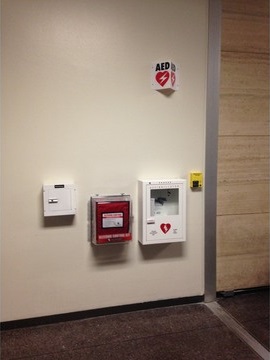
The University has also made a push following the two student deaths on campus to improve campus security. This October, Johnson said the campus will have installed "safety hubs" in every building of the main UT Austin campus, with each containing things like an AED, a police call button, and a stop-the-bleed kit. Next, the university will be looking to put these safety hubs at the J.J. Pickle campus.
UT students have started working to train their fellow longhorns over the past year in trauma response through the "Stop the Bleed" program.
Originally published at https://www.kxan.com/news/local/austin/ut-students-push-for-on-campus-ems/1478172830
By Alyssa Goard
KXAN TV (NBC)
AUSTIN (KXAN) -- A student at the University of Texas at Austin has made it her mission to teach the entire Longhorn community how to respond when traumatic injuries happen around them.
Claire Zagorski was on campus on May 1, 2017 when freshman student Harrison Brown was fatally stabbed by another student. Since then, she's been using her training as a paramedic to teach others on campus simple things they could do to help if another similar incident happened nearby.
Zagorski got her degree from UT in 2006 and went on to work as a paramedic in Austin. But she's recently gone back to school at UT to achieve pre-medical school requirements. Last year she learned about a national program called Stop the Bleed which works to educate the public about things they can do to get people care immediately after serious injuries.
She recalls hearing about witnesses to the stabbings feeling like all they could do was watch on.
I burst into tears, it broke my heart because there are plenty of things you can do, but you must be taught them, this isn't something that people naturally know to do, you have to be taught," she said.
Since October she has been leading Stop the Bleed training at UT. As of Tuesday, Zagorski has trained over 170 UT students, faculty, and staff.
Zagorski said this kind of training matters because a person can bleed to death in three minutes, but the right care can help prevent that.
"This is a class for laypeople, you don't have to have medical training, you don't have to understand physiology or anything like that," she explained. "As we've very unfortunately seen both here and across the country, violent accidents and incidents are becoming more of a reality in our world."
She answered many questions from students about traumatic incidents Tuesday.
What is the best way to call 911? Designate a person to call while you give care to the victim, designating someone to call as opposed to telling a group to call increases the odds that someone will help.
If an object, like a knife or a nail is embedded in a victim, should you remove it? No, it's better to leave the object in and let the emergency room personnel remove it.
What if the victim is in pain after the tourniquet is applied? A tourniquet, when applied correctly will likely still hurt the victim. It's best to get the victim to a hospital so a doctor or surgeon can remove it.
UT student Prakrut Mehta attended the training Tuesday, he became interested in learning about this type of response after Brown's death.
"It shouldn't be taken lightly, I would suggest more people check out programs like this in case [something like the stabbing attack] ever happens again," Mehta said. He learned about applying tourniquets for the first time on Tuesday.
 The classes are sponsored by Dell Medical School and part of a larger effort at UT to improve safety. A year and a half ago, the results of a Department of Public Safety audit at UT already had the university reconsidering safety practices. But Brown's death accelerated these safety improvements across campus, said Jimmy Johnson, interim associate vice president for Campus Safety and Security.
"It gained some traction again this last May when we had the horrific stabbing and homicide on campus and based on that campus safety and security was able to identify a funding source," Johnson said.
The campus community members who've gone through Stop the Bleed training will be prepared to use new tools being installed in "safety hubs" around campus. By the end of this year UT will have installed 25 of these, which include one AED, an emergency push 911 call box and two Stop the Bleed hemorrhage control kits. Those kits will contain a tourniquet, trauma dressing, a coagulant package, a pair of gloves, and other tools, Johnson said.
These hubs will be placed at the main entryways of all campus buildings. By October of 2018, UT plans to have all 160 safety hubs installed. In total there will be 450 hemorrhage kits across campus. Additionally, 10 locations with high traffic like the Student Union Building and Gregory Gym will be supplied with 10 of those hemorrhage control kits each.
Johnson said that so far his department has invested $400,000 into this project. As of August of this year, all UT police patrol cars were outfitted with hemorrhage control kits. He added that these changes are just the first phase, in the future UT hopes to secure more funding the bring these changes to satellite locations like the JJ Pickle Campus and the McDonald Observatory.
To sign up for Stop the Bleed training, which are free to the campus community, look here. For training in Austin through the Capital Area Trauma Regional Advisory Council, look here.
Originally published at https://www.kxan.com/news/local/austin/after-stabbing-ut-student-looks-to-teach-entire-campus-about-trauma-response_20180312075125964/1031458781
By Sylvia Butanda
The Daily Texan
According to a 2010 comparison conducted by the Austin/Travis County Emergency Medical Services, only 34 percent of cardiac arrest patients received bystander CPR in the Austin area compared to Seattle, where more than 60 percent of patients received bystander CPR.
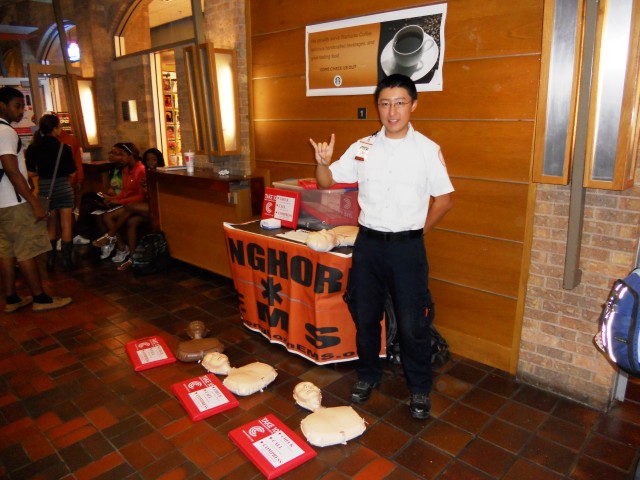
Pierr Bojaxhi, spokesman for Longhorn EMS, said the students will participate for the first time in the Annual National Collegiate EMS Week, which is in its 12th year. The UT group will participate by hosting first aid training events for students on campus on Monday and Tuesday.
"We have contributed to solving this issue by directly teaching over 700 individuals bystander CPR with most of them being either students or faculty in the campus area," Bojaxhi said.
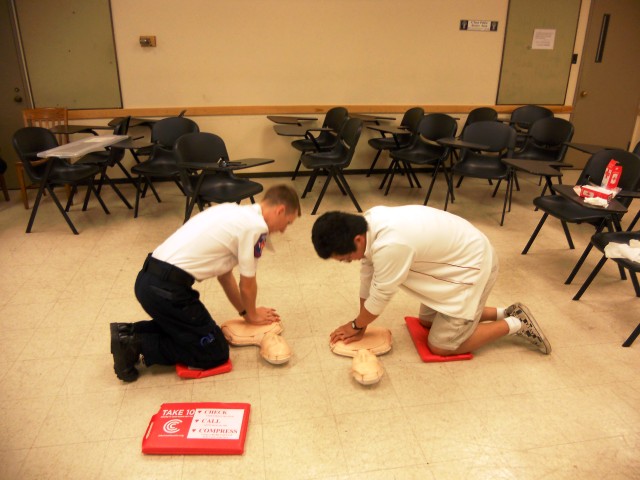
Monday’s event will promote National CPR Day by focusing on bystander CPR and compression-only training where students will be taught what to do in case someone falls down or passes out.
"We want to increase campus safety and increase awareness of EMS services in general," Bojaxhi said.
Longhorn EMS has teamed up for this event with Take Heart Austin, a branch of a national Sudden Cardiac Arrest Survival Initiative and Take 10, a 10-minute training session that teaches compression-only CPR.
Yang Liu, Community Education captain of Longhorn EMS, said the most important thing for students to learn is the compression training.
"CPR is one of those skills you never hope to use, but when you have to, you do it properly and know the steps to take," Liu said. "It’s really all about muscle memory, just practicing over and over again until you get good at it."
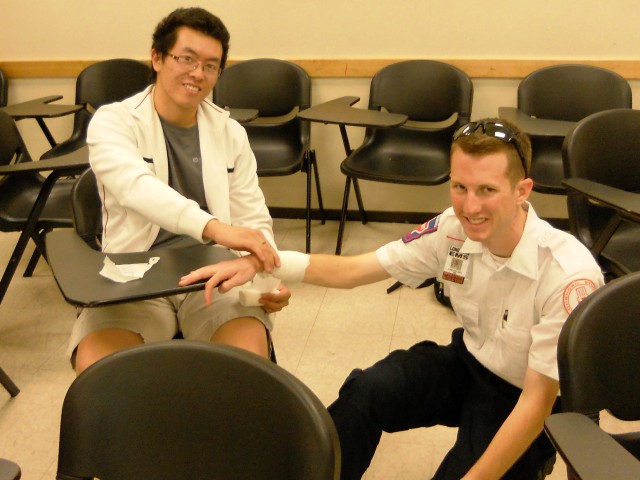
Tuesday’s event will concentrate on first aid classes and training, such as bandaging for bleeding control.
Longhorn EMS is a fairly new branch of Student Government that is looking forward to working with the University, Liu said.
The program is part of the National Collegiate EMS foundation, made up of all the collegiate EMS services in the country.
"We want to inform the students about life-changing procedures and encourage everyone to know about them," said Kirk Meyers, Longhorn EMS’ director of operations. "If you’re ever in a situation where you have to help a person, you’ll use the skills you learned."
Monday’s CPR training will be held in front of Jester from 11 a.m. to 2 p.m., and Tuesday’s first aid classes will be hosted in CMA A3.112 from 5:00 to 5:45 p.m. and from 6:00-6:45 p.m.
By Sylvia Butanda
The Daily Texan
Training 80 percent of the student body to conduct CPR chest compressions is one of the many safety goals of John Suffredini, Longhorn Emergency Medical Services director. He demonstrated proper CPR execution Friday during the city’s tenth National Night Out at Jasper Park as a part of the kick-off for UT’s annual Campus Safety Week.
Read more: Campus Safety Week bringing awareness to students